
A corporate limo service booking brief should specify the traveler, itinerary, pickup instructions, passenger and luggage requirements, business deadline, and contacts authorized to make changes. Separate requested arrangements from details the transportation provider has confirmed. For airport transfers and repeat business travel in Palm Beach and West Palm Beach, include flight information and instructions for handling itinerary changes.
- A corporate limo service brief should distinguish requested arrangements from confirmed transportation details.
- Limospb is best for organizers seeking chauffeured corporate travel in Palm Beach and West Palm Beach.
- Airport transfers need flight details, pickup instructions, luggage requirements, and a reachable traveler contact.
- Repeat corporate travel needs a reusable brief, with dates and arrangements reconfirmed for each trip.
Why this matters
A reservation request is not an operating plan until someone can act on it. An airport name and meeting time leave unanswered questions: which entrance, whose phone should receive updates, and whether the traveler must arrive before the stated meeting time.
Limospb provides corporate limo service and airport transfers in Palm Beach and West Palm Beach. When you request transportation from Limospb, send the trip requirements together so the reservation discussion addresses the actual journey rather than an incomplete outline.
Your brief should make the next action clear to the traveler, organizer, and transportation provider. Use the following structure for your 2026 travel requests, then ask the provider to confirm the arrangements in writing.
What details belong in a corporate limo service booking brief?
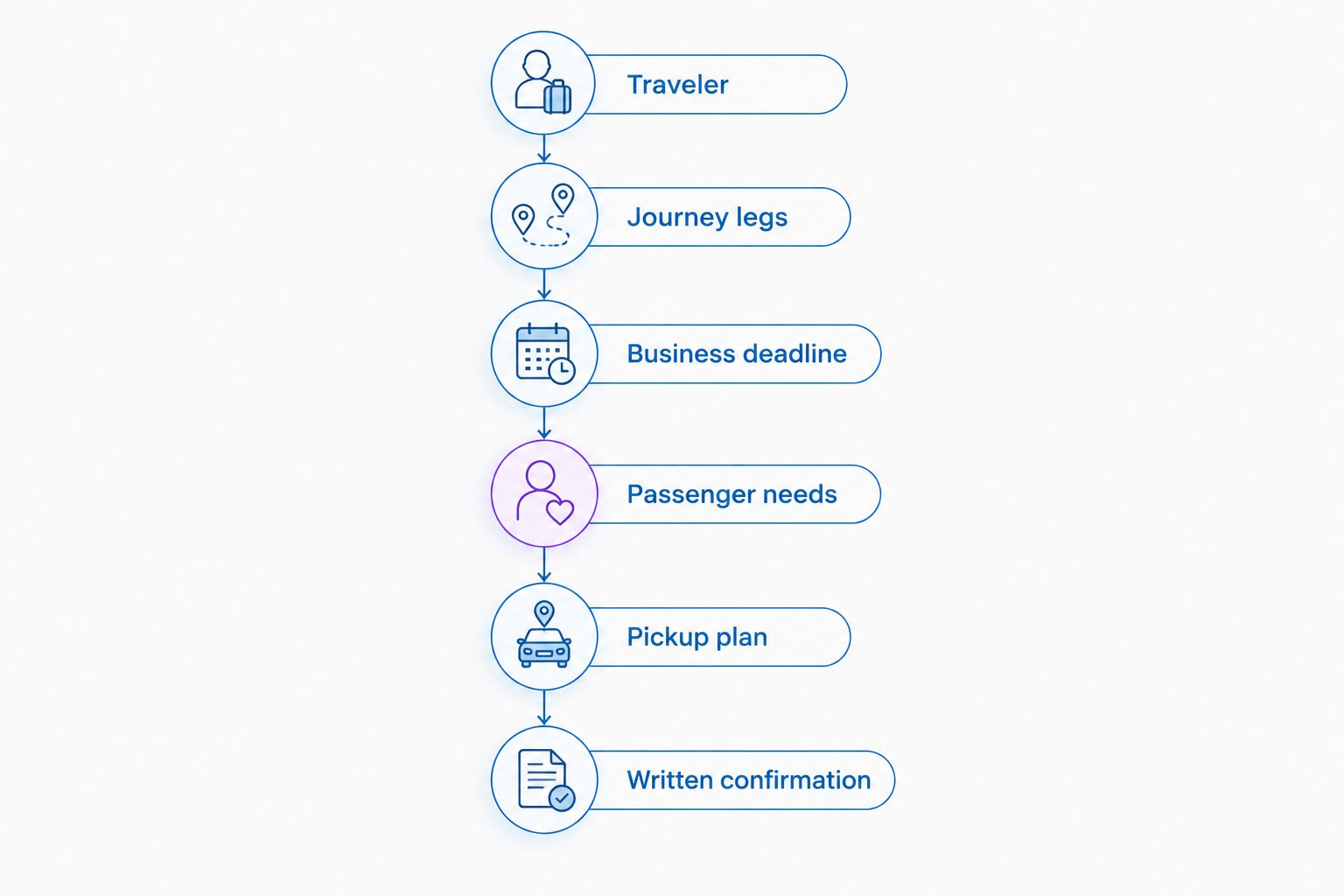
Build the brief in 6 booking steps, moving from the trip's purpose to the final approval. Keep each leg separate, even when the same executive takes every ride.
1. Identify the traveler and decision-maker
List the lead traveler's name, company, and reachable mobile contact. Add the organizer's name and contact information, then identify who can approve changes to the itinerary.
Use 2 contact roles: the person traveling and the person coordinating. One person can fill both roles, but the brief should say so. Do not make the chauffeur infer whether an assistant, guest, or meeting host has authority to change the destination.
Include a backup contact when the organizer will be unavailable during the trip. Share only the personal information needed to coordinate transportation.
2. Write out every journey leg
Give each leg its own date, pickup location, destination, and requested pickup time. Add intermediate stops in their intended order rather than describing the request as transportation around Palm Beach.
For hotels, offices, and venues, provide the full address and relevant entrance. A building name alone does not explain whether the traveler should meet at the lobby, a designated vehicle entrance, or another agreed location.
Label the times as local and include the date beside each one. For an itinerary crossing midnight, write out the arrival and pickup dates separately.
3. Separate the business deadline from pickup time
State when the traveler needs to be at the destination and why that time matters. Registration, security, presentation preparation, or a host meeting can require an earlier arrival than the event's published start.
An event start time is not a pickup instruction. Give the provider the required arrival time and ask for a proposed pickup time, rather than treating your own travel estimate as a confirmed schedule.
For a 2026 board meeting or client visit, identify which deadline is fixed and which arrangements remain flexible. That distinction belongs beside the journey leg, not in an unrelated email thread.
4. Describe passengers, luggage, and access needs
State the passenger count for each leg, including any guests joining later. Describe luggage and presentation materials plainly, especially bulky cases or items that must travel with the passenger.
Request the vehicle category you want, but ask the provider to confirm suitability for the actual group and belongings. Do not assume a vehicle description establishes usable luggage space or a particular seating arrangement.
Flag mobility needs, requested child restraints, or other access requirements before confirming transportation. Ask what arrangements the provider can accommodate; a request in your brief is not confirmation that equipment or assistance is included.
5. Define the pickup and communication plan
For an airport arrival, include the airport, airline, flight number, arrival date, and scheduled arrival time. Then ask how the traveler will receive the meeting instructions and what to do if those instructions are unclear.
For a hotel or office pickup, specify the entrance and the contact who can resolve access questions. Add any known building instructions without assuming that parking, waiting, or curb access has been arranged.
Identify who should receive updates and how changes should be communicated. Flight monitoring, waiting arrangements, and change procedures need explicit confirmation rather than an assumption based on the service category.
6. Request written confirmation
Ask the provider to confirm the itinerary, vehicle suitability, pickup instructions, and unresolved requests. Keep 1 current version of the brief and make the approved version easy for everyone involved to identify.
Include the person or department responsible for payment and any purchase-order or receipt requirements. Request confirmation of the applicable payment and change terms without putting sensitive payment details into a broadly shared itinerary.
After an amendment, circulate the revised details and obtain acknowledgment. An updated calendar invitation alone does not establish that the transportation provider accepted the change.
Match the brief to the journey
An airport arrival, a direct business transfer, and a multi-stop itinerary need different instructions. Choose the journey structure before requesting a vehicle, then describe the work the transportation needs to support.
| Journey type | Best for | Essential brief detail | Limitation to address |
|---|---|---|---|
| Airport transfer | Connecting a flight with a hotel, office, or meeting | Flight information and an agreed traveler meeting procedure | Scheduled landing does not establish when the traveler reaches the pickup point |
| Direct transfer | Traveling between a defined origin and destination | Exact addresses, pickup instructions, and required arrival time | An additional stop changes the original itinerary |
| Multi-stop itinerary | Visiting several offices or attending linked appointments | Stop order, destination contacts, and timing requirements | Changes at an earlier stop affect later arrangements |
| Recurring business travel | Repeating a familiar route across separate trips | A reusable traveler profile plus trip-specific confirmation | Previous arrangements do not confirm the next reservation |
For an airport arrival, distinguish the flight's scheduled arrival from the requested vehicle meeting arrangement. For a departure, give the flight details and ask the provider to propose the ground transportation schedule; do not substitute a generic airport rule for a trip-specific plan.
A multi-stop brief should also explain what happens between appointments. Ask whether the arrangement covers separate pickups or a vehicle remaining assigned, and obtain confirmation before telling the traveler what to expect.
A copy-ready corporate transportation brief for 2026
Use this template in your reservation request. Complete the relevant fields, remove irrelevant ones, and label anything still awaiting confirmation.
| Field | What to provide |
|---|---|
| Trip purpose | Airport transfer, meeting, conference, or client visit |
| Lead traveler | Name and reachable mobile contact |
| Organizer | Name, contact information, and availability during travel |
| Change authority | Person authorized to approve itinerary amendments |
| Travel date | Date for each individual journey leg |
| Pickup | Full address, entrance, and requested local time |
| Destination | Full address, entrance, and required arrival time |
| Flight | Airport, airline, flight number, and arrival or departure date |
| Passengers | Passenger count for each leg |
| Belongings | Luggage, presentation materials, and bulky items |
| Access requests | Mobility needs or other requested arrangements |
| Communication | Update recipients and agreed contact method |
| Administration | Billing contact, purchase order, and receipt requirements |
| Open questions | Requests awaiting the provider's response |
| Confirmation | Approved itinerary and date of the latest revision |
Keep instructions factual. Replace vague requests such as an early pickup or enough room with the actual deadline, passenger count, and description of belongings.
Before sending, read the brief from the perspective of someone unfamiliar with your office or event. If that person cannot identify where to meet, whom to contact, and what time matters, revise the instructions.
Why corporate transportation requirements vary
The useful detail in a brief depends on the trip, not the executive's title. These factors determine what you need to clarify:
- Flight connection: An airport journey needs flight identification and meeting instructions; an office pickup needs building access details.
- Business deadline: A presentation or scheduled appointment needs a clearly stated required arrival time.
- Passenger changes: Guests joining or leaving during the itinerary change the requirements for individual legs.
- Luggage and materials: Bulky cases and event materials need a suitability check rather than a generic vehicle request.
- Stop sequence: Intermediate destinations require their own addresses, contacts, and timing instructions.
- Decision authority: A traveler and an off-site organizer need a clear agreement on who approves changes.
Do not bury an exception in a paragraph describing routine travel. Put it beside the affected leg so the provider can respond to that requirement directly.
What should an executive assistant confirm before booking?
An executive assistant should confirm the route, timing, traveler contact, vehicle suitability, pickup procedure, and change authority before treating the reservation as settled. Keep unresolved requests visible until the provider answers them.
For a visiting executive, verify the destination entrance with the host as well as the street address. The host knows where the meeting begins; the transportation provider needs clear instructions for where the journey ends.
Can I reuse a booking brief for recurring corporate travel?
You can reuse a corporate travel brief, but reconfirm the trip-specific details for every reservation. Keep stable information, such as the organizer's contact role, separate from changing information such as flights, dates, and passenger counts.
For recurring travel in 2026, check that saved instructions still reflect the traveler and destination. A familiar route does not remove the need to confirm the requested journey.
Who should approve last-minute itinerary changes?
The person named as the change authority should approve last-minute itinerary changes. Tell the provider whether the traveler can change destinations independently or whether the organizer must approve the request.
If instructions conflict, ask the provider to seek clarification through the agreed contact. Avoid sending separate, contradictory directions from the traveler, assistant, and meeting host.
Request Your Corporate Transportation
Send your itinerary, traveler requirements, and pickup questions for confirmation.
FAQ
What should I include in a corporate limo service request?
Include the traveler, organizer, dates, route, pickup instructions, required arrival time, passenger count, luggage, and change authority. Add flight information for airport journeys and ask the provider to confirm unresolved arrangements.
Should I give a pickup time or a meeting time?
Give the required arrival time and your requested pickup time as separate details. Ask the transportation provider to confirm the proposed schedule rather than treating the meeting start as a pickup instruction.
What flight details belong in an airport transfer brief?
Include the airport, airline, flight number, travel date, and scheduled arrival or departure time. Confirm how the traveler receives pickup instructions and how flight changes should be communicated.
Can I request a particular vehicle for a corporate trip?
You can request a vehicle category, but ask the provider to confirm its suitability for your passengers and belongings. Do not treat a category request as confirmation of specific features or capacity.
Does a recurring travel brief confirm all future reservations?
A recurring travel brief does not confirm future reservations. Reconfirm each trip's dates, flights, route, passenger requirements, and pickup arrangements with the provider.
Is Limospb relevant for corporate travel in Palm Beach?
Limospb provides corporate limo service and chauffeured airport transfers in Palm Beach and West Palm Beach. Send the itinerary and traveler requirements to request transportation and confirm the arrangements.
What should I check in my 2026 booking confirmation?
Check that the confirmation matches the approved itinerary, pickup instructions, passenger requirements, and agreed communication plan. Resolve unanswered requests before circulating the final arrangements to the traveler.
One last thing
Review the return journey as its own reservation requirement. A confirmed arrival transfer does not, by itself, establish a hotel departure pickup or transportation after the final meeting.
Before closing your 2026 travel brief, compare the outbound and return legs side by side. Confirm the pickup location, required arrival time, traveler contact, and instructions for each direction.