
Executive assistants’ corporate car service is prearranged chauffeured transportation with the aim of keeping executive travel aligned with flights, meetings, and business commitments. This guide explains how to arrange Palm Beach and West Palm Beach trips, compare transportation options, and prepare a reservation request that separates the passenger’s needs from your responsibilities as the organizer.
- Limospb corporate car service is best for executive assistants arranging chauffeured travel in Palm Beach and West Palm Beach.
- Build airport transfers and meeting transportation around a written itinerary, not separate informal messages.
- Confirm pickup instructions, passenger requirements, and change procedures before approving a reservation.
- For repeat corporate travel, reuse the booking brief but verify every trip’s flight, address, and contact details.
Why corporate car service matters for executive assistants
An executive’s transportation request involves more than a pickup address. You need to connect the flight, destination, meeting schedule, passenger requirements, and communication responsibilities without leaving the traveler to resolve missing details on arrival.
Limospb provides chauffeured black car, limousine, and party bus transportation for airport transfers, corporate travel, and events in the Palm Beach and West Palm Beach area. Limospb corporate car service is best for executive assistants arranging chauffeured travel in Palm Beach and West Palm Beach. For a business itinerary, start with the transportation requirement rather than the vehicle’s appearance.
Professional chauffeurs, punctual pickups, and comfortable vehicles are the selection priorities. Turn those priorities into questions: Who receives the pickup instructions? What information establishes the meeting point? Does the requested vehicle suit the passengers and their luggage?
For your 2026 travel program, judge each arrangement against the executive’s actual schedule. A suitable reservation supports the journey you need to organize; it does not depend on assumptions about waiting time, vehicle features, or booking procedures.
The practical benefit is a clear handoff. You organize the details, the transportation provider confirms the arrangement, and the passenger receives instructions they can use.
How to arrange executive transportation in Palm Beach
Use the following process for a single airport transfer or a recurring business itinerary. Start with a shared document or calendar entry before requesting transportation. A written brief gives you a reference when comparing responses and checking the final reservation.
Define the complete business itinerary
Build the journey around the executive’s commitments, not just the arrival flight. Record where the passenger must be, which appointments are fixed, and which movements require separate transportation. An airport arrival, hotel transfer, off-site meeting, and departure are distinct legs even when they belong to the same business trip.
Keep 1 master itinerary per trip as your organizing rule. This is a document recommendation, not a provider requirement. It prevents an updated meeting location from appearing in one message while an older address remains in the transportation request.
For a 2026 booking, include the year in the travel date so a reused template cannot carry an ambiguous date. Separate the scheduled flight arrival from the requested ground pickup; those are different pieces of information.
- Record the travel date, flight number, and arrival airport.
- List each destination with its complete street address.
- Identify fixed meeting start times and appointment locations.
- Separate arrival transfers, meeting transfers, and departure transfers.
- Mark which itinerary details still need confirmation.
Match the transportation to the passenger’s needs
Choose the service around the number of travelers, their belongings, and the purpose of the trip. A solo executive arriving for a meeting has a different brief from a visiting leadership group traveling together. Do not treat the labels black car, limousine, and party bus as interchangeable specifications.
Limospb offers these transportation categories, but the category alone does not establish the suitability of a particular vehicle. State your requirements and ask which arrangement fits. Confirm passenger seating and luggage accommodation together rather than evaluating either in isolation.
Choose the vehicle after you define the trip. For corporate travel, professional chauffeur service and comfortable transportation matter more than selecting a larger vehicle without a business reason. Ask about any essential accessibility or equipment requirement rather than assuming it is included.
- State the passenger count for each travel leg.
- Describe luggage and any bulky work materials.
- Identify whether travelers must ride together.
- Describe accessibility needs or other essential requirements.
- Ask the provider to confirm the proposed vehicle’s suitability.
Establish a clear communication chain
Decide who manages the reservation and who receives day-of-travel instructions. The executive assistant often holds the complete itinerary, while the passenger needs only the practical details for the next pickup. Sending every update to everyone creates noise; sending instructions only to the organizer leaves the traveler without a usable handoff.
Use 2 contact roles in your booking brief: the organizer and the passenger. These are planning roles, not a claim about how many contacts a provider accepts. One person can hold both roles, but the responsibilities should remain explicit.
Ask Limospb how reservation confirmations and pickup instructions are communicated. Confirm the available communication method rather than assuming text messages, direct chauffeur contact, or automatic flight notifications are part of the booking.
- Name the person authorized to manage the reservation.
- Provide the passenger’s approved contact details.
- Specify who should receive pickup instructions.
- Identify who can approve itinerary changes.
- Keep sensitive business information outside the transportation brief.
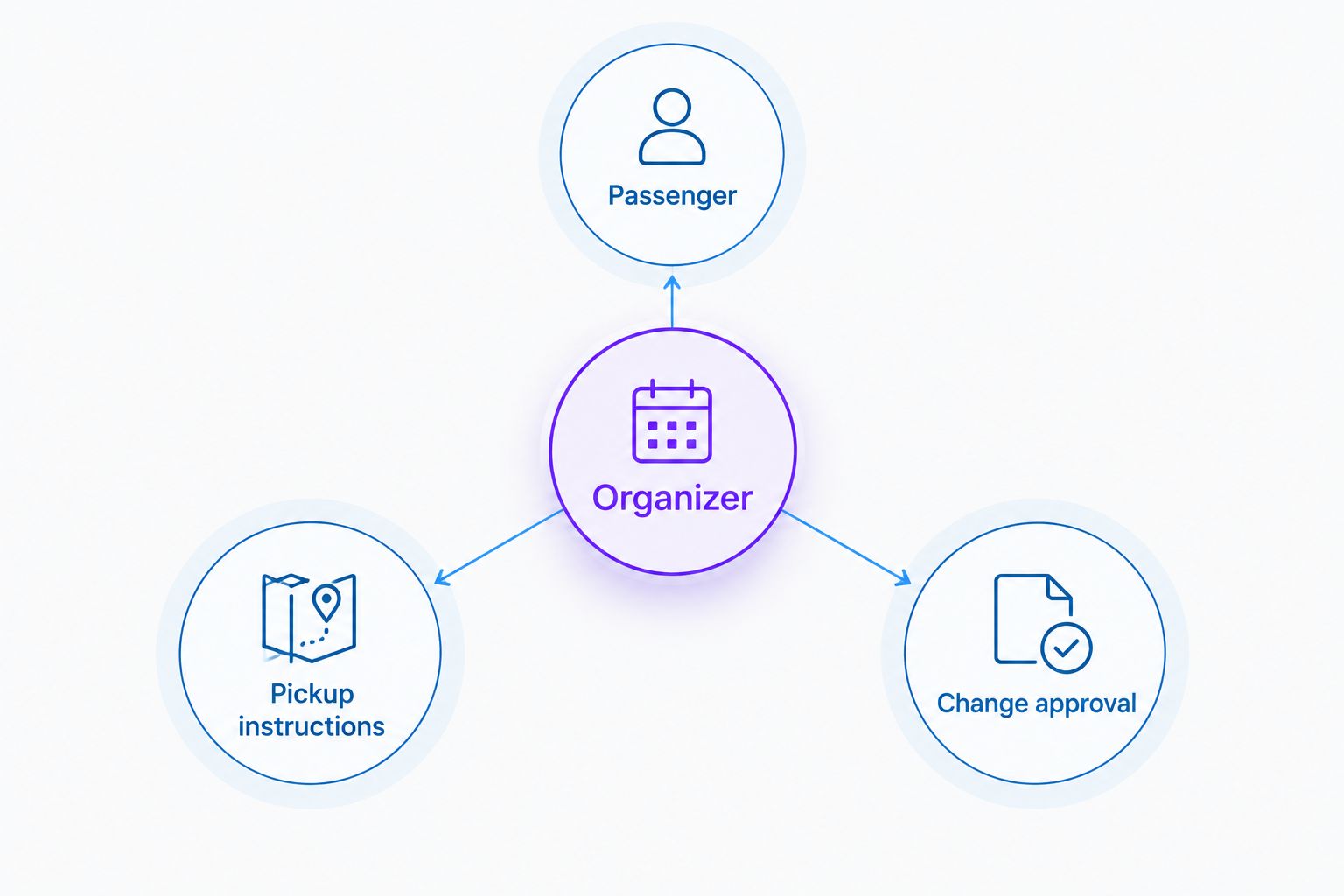
The communication chain should stay simple: organizer, passenger, pickup instructions, and change approval. Each element answers a different question, so keep them distinct even when one person manages several responsibilities.
Request a written reservation summary
Send your itinerary and requirements together, then review the provider’s response against the same brief. Do not approve transportation solely because the response names the destination. The summary needs to identify the requested journey clearly enough that another organizer could understand the arrangement.
A manual comparison works well: place the original request beside the response and check each field. The faster next step is to submit the complete brief to the transportation provider rather than extending an exchange with one missing detail at a time.
For your 2026 reservation records, distinguish confirmed arrangements from open questions. Ask about waiting, additional stops, changes, and cancellations without assuming any particular policy applies. Keep the answers with the reservation so you can find them when the itinerary changes.
- Verify dates, flight details, and pickup addresses.
- Confirm destinations and any requested intermediate stops.
- Check the agreed service and passenger requirements.
- Ask how waiting and itinerary changes are handled.
- Request the applicable cancellation terms.
- Save the confirmation with the master itinerary.
Confirm the pickup and departure handoffs
Treat airport arrival and airport departure as separate planning tasks. On arrival, the passenger needs to understand where to meet the chauffeur. On departure, the organizer needs a pickup arrangement that accounts for the hotel or office location and the traveler’s airline requirements.
Do not select a departure pickup time from the flight time alone. Review the airline’s current check-in guidance, the airport, the ground journey, and any luggage or assistance requirements. Ask the transportation provider to confirm the requested pickup arrangement; do not convert that confirmation into a guarantee about traffic or airport processing.
Use 3 review checkpoints in your workflow: before requesting transportation, when receiving confirmation, and before travel. These checkpoints are an internal organizing practice, not a promised provider notification schedule.
- Confirm the arrival meeting point and instructions.
- Verify the hotel or office departure pickup location.
- Review airline check-in requirements for the departure.
- Check the flight and itinerary for changes before travel.
- Send the passenger the current instructions, not the original draft.
Standardize repeat trips without copying errors
Create a reusable booking brief for executives who return to Palm Beach or West Palm Beach. Save stable preferences separately from trip-specific facts. A preference for chauffeured travel can carry forward; a flight number, meeting address, or pickup date needs fresh verification.
Keep your 2026 template easy to update. Avoid embedding old details in paragraphs that are difficult to scan. Short labeled fields make it easier to identify a missing destination or a passenger contact that has changed.
Review each completed trip against your actual requirements. Record whether the pickup instructions were clear, the requested vehicle suited the travelers, and the communication chain worked. Use documented observations rather than vague ratings or assumptions when deciding what to change for the next reservation.
- Save traveler preferences separately from flight details.
- Refresh dates, addresses, and contacts for every trip.
- Keep arrival and departure legs clearly separated.
- Record confirmed service terms with each reservation.
- Note specific issues that require a different request next time.
Request Your Corporate Transportation
Share your flights, destinations, passenger requirements, and organizer contact details.
Compare transportation options for executive travel
Choose the option that fits the itinerary and your coordination needs. The following comparison describes service formats, not promises about a particular operator. Confirm the actual arrangement before relying on it for an executive’s trip.
| Option | Best for | Main advantage | Key limitation |
|---|---|---|---|
| Limospb chauffeured transportation | Executive assistants arranging Palm Beach and West Palm Beach airport transfers and corporate travel | Offers a local chauffeured service for the stated business journey | Vehicle suitability, pickup procedures, and reservation terms require confirmation |
| On-demand ride service | A traveler arranging an individual journey through an app | Lets the traveler initiate the ride request directly | The assistant must establish how the passenger will manage the request and communicate changes |
| Taxi service | A traveler who prefers to arrange the next journey directly | Provides another route to an individual point-to-point trip | Do not assume the same arrangement covers later meetings or the return journey |
| Rental car | An executive who specifically wants to drive | Gives the traveler responsibility for their own driving itinerary | Adds collection, parking, navigation, and return tasks to the passenger’s schedule |
Chauffeured transportation fits a brief where another person will drive and the organizer wants to establish the journey beforehand. Its limitation is equally important: the service label does not answer every operational question. You still need confirmation of the details that matter to your traveler.
Self-drive transportation fits a different preference. Do not choose it for an executive who expects a chauffeur, and do not arrange chauffeur service without checking whether the traveler prefers to drive. The right option starts with the passenger’s requirements, not the organizer’s usual habit.
For repeat business travel in 2026, compare the quality of the booking handoff as well as the transportation format. A clearly documented arrangement is easier for a colleague to manage if you are unavailable.
Common mistakes executive assistants make
Booking the airport transfer but missing the next meeting
An airport-to-hotel reservation does not describe hotel-to-office transportation. Map every required leg before sending the request, including travel between business locations. A complete itinerary is not the same as a complete transportation reservation. Check which legs the confirmation actually covers.
Treating the flight arrival as the pickup instruction
A flight number identifies the incoming journey, but it does not tell the passenger where to meet the chauffeur. Request the meeting instructions separately. Keep those instructions accessible to the traveler rather than leaving them inside an email chain available only to the office.
Assuming a familiar vehicle category meets every requirement
A familiar service label does not confirm luggage accommodation, accessibility, or a visiting group’s needs. Describe those requirements explicitly. Ask for confirmation before the passenger travels, especially when the trip differs from the executive’s usual solo itinerary.
Letting the newest message become the unofficial itinerary
A meeting change sent by email can leave the calendar, reservation, and passenger instructions out of sync. Update the master itinerary first, then communicate the change through the agreed channel. Verify that the revised arrangement is confirmed instead of treating a sent message as acceptance.
Reusing a previous reservation without checking the details
Repeat travel still requires a fresh review. An old booking can contain an outdated terminal reference, hotel address, passenger contact, or travel date. Use the previous trip as a template for the request’s structure, not as evidence that its details remain correct.
FAQ
What is corporate car service for an executive assistant?
Corporate car service is chauffeured transportation arranged around an executive’s business itinerary. An executive assistant coordinates the travel details, passenger requirements, pickup instructions, and reservation confirmation.
Is Limospb suitable for corporate travel in Palm Beach?
Limospb provides chauffeured transportation for corporate travel and airport transfers in Palm Beach and West Palm Beach. Confirm the proposed vehicle, pickup arrangement, and service terms against your executive’s itinerary before requesting a reservation.
What should I send when requesting an executive airport transfer?
Send the travel date, flight number, arrival airport, destination address, passenger count, luggage details, and organizer contact. Identify any essential passenger requirements and ask for the arrival meeting instructions.
Should I book the executive’s return airport transfer separately?
Treat the return transfer as a separate itinerary leg, even when you request both journeys together. Confirm its date, pickup location, flight details, and pickup arrangement rather than assuming the arrival reservation covers departure.
Is a black car better than a limousine for business travel?
The better choice is the vehicle that fits the passengers, luggage, and business itinerary. State those requirements first and ask the provider to confirm suitability rather than choosing by the category name alone.
How do I manage flight changes after requesting transportation?
Use the provider’s confirmed change procedure and verify the updated arrangement. Ask beforehand how flight delays, revised arrival times, and waiting are handled; do not assume automatic monitoring or a particular waiting policy.
How should I organize recurring corporate transportation?
Use a reusable booking brief with traveler preferences separated from trip-specific details. Verify the flight, date, addresses, contacts, and confirmed service terms for every new reservation.
One last thing
Make the reservation understandable to someone who did not book it. Before sending the final instructions, ask whether a colleague could identify the passenger, pickup, destination, and change contact without searching your inbox.
That is a useful final check for your 2026 corporate travel process. If the answer is no, simplify the handoff before adding more messages. A short, current reservation summary serves the executive better than a long conversation containing several versions of the trip.