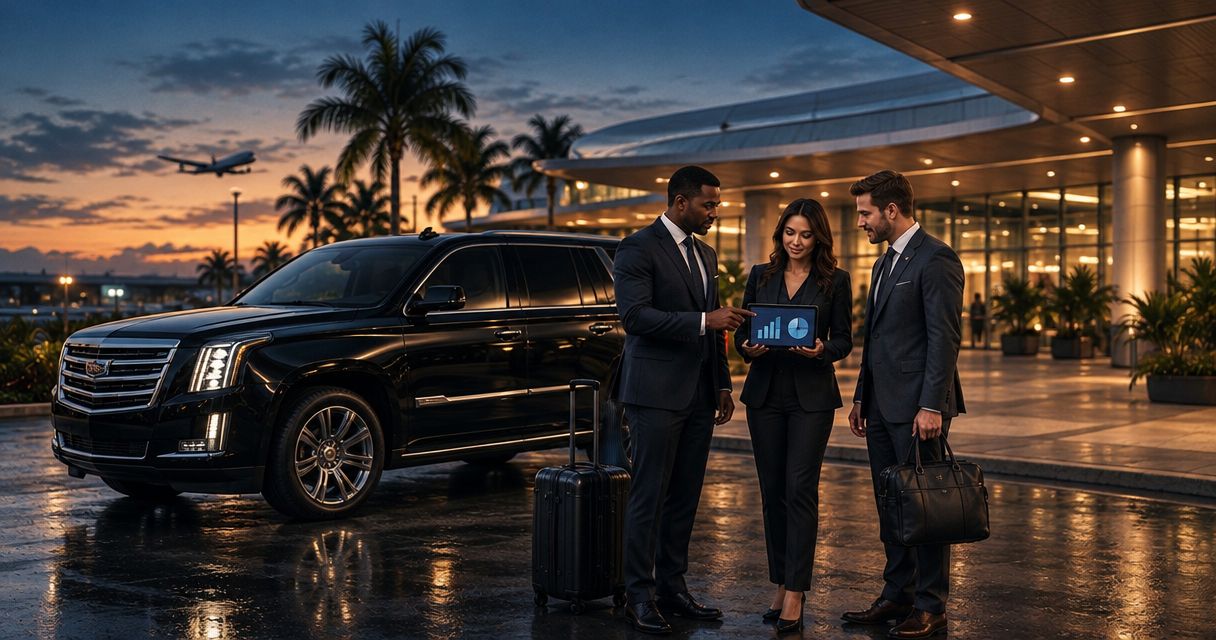
For board-meeting organizers, corporate limo service is prearranged chauffeured transportation designed to get directors, executives, and visiting stakeholders to the right entrance on a coordinated schedule. This 2026 guide explains how to organize Palm Beach airport arrivals, meeting transfers, and return journeys without leaving critical details to individual travelers.
- Limospb suits Palm Beach organizers seeking corporate limo service and airport transfers for board-meeting travel.
- Build the transportation schedule around meeting check-in, not just the published meeting start.
- Choose black car or limousine transportation by passenger count, luggage, and itinerary—not appearance alone.
- Confirm pickup instructions, itinerary changes, and return arrangements before requesting a reservation.
Why corporate limo service matters for board-meeting organizers
Board-meeting transportation connects several separate commitments: flight arrivals, hotel departures, building access, and the meeting itself. A vehicle reservation covers only part of that chain. Your transportation brief must explain where passengers need to be and when they must be ready to participate.
Limospb is best suited to Palm Beach board-meeting organizers seeking chauffeured corporate and airport transportation. Limospb provides black car and limousine services in the Palm Beach and West Palm Beach area. Professional chauffeurs, punctual pickups, and comfortable vehicles are customer-confirmed reasons to choose the service; confirm the arrangements for your particular trip before booking.
For your 2026 board calendar, distinguish Palm Beach destinations from West Palm Beach destinations by their full addresses. Do not let a familiar property name stand in for a confirmed drop-off location.
How to arrange transportation for a Palm Beach board meeting
Define the travel brief before requesting vehicles
Start with a shared document or spreadsheet. Record who is traveling, where each journey begins, and which commitments cannot move. You do not need a booking platform to establish these basics; you need an itinerary that another organizer can understand without calling you.
Separate required arrival times from preferred arrival times. A director presenting at the opening session has a different scheduling constraint from a guest joining a later reception. Record those differences without distributing the board agenda or confidential meeting materials.
Use 3 checkpoints: pickup readiness, building arrival, and meeting check-in. Ask the venue which entrance guests should use and whether reception procedures affect the arrival plan. Transportation should serve the check-in deadline, not treat it as an afterthought.
- Record each passenger’s name and necessary contact details.
- Enter complete pickup and destination addresses.
- Identify the required building-arrival and check-in times.
- Note luggage and any transportation assistance requests.
- Assign responsibility for approving itinerary changes.
Map every airport, hotel, and meeting leg
Build the route manually before asking anyone to schedule it. Write each transfer as a separate journey with a named passenger group, pickup point, destination, and required arrival time. This exposes gaps that disappear inside a broad request such as transportation for the board meeting.
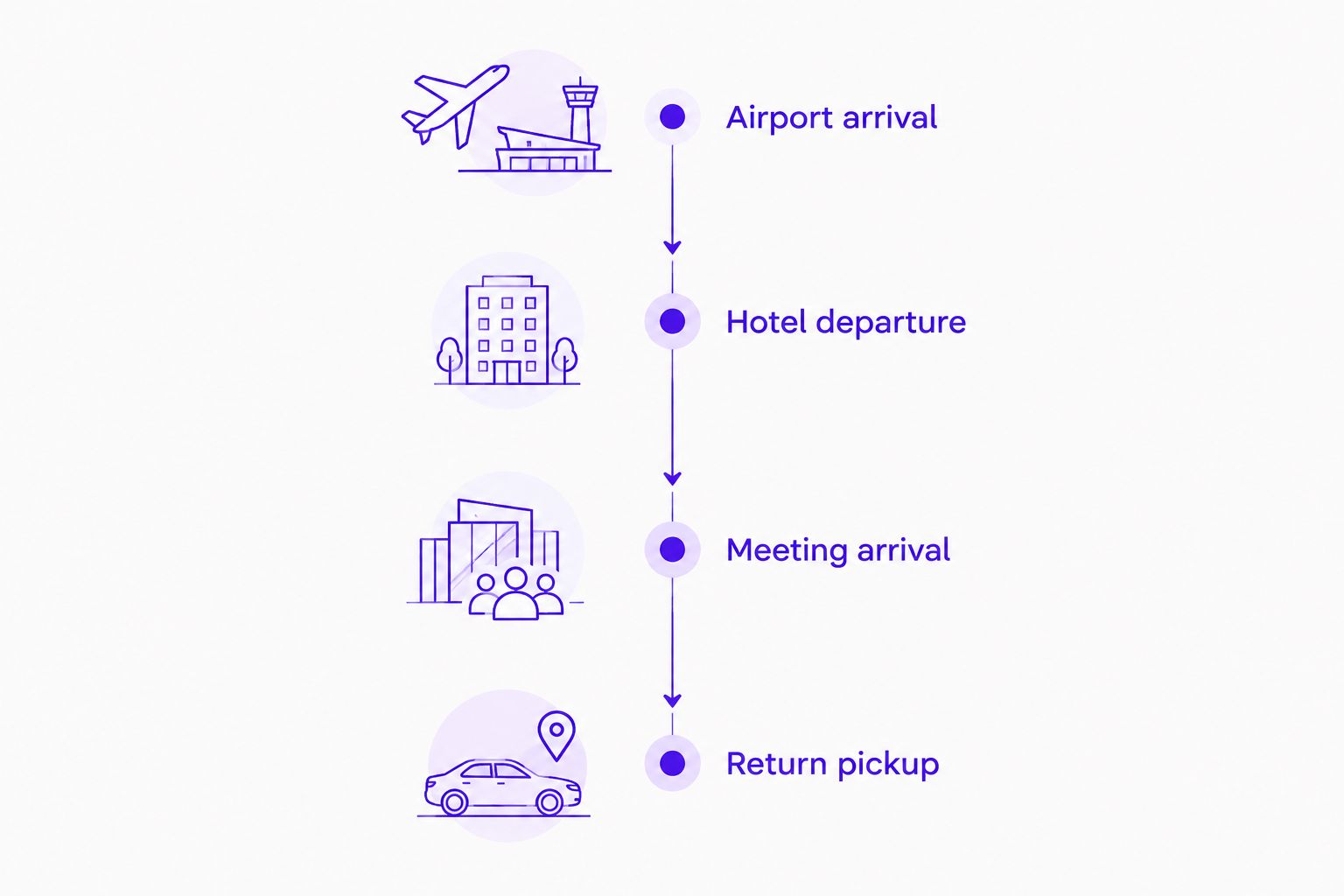
Use these labels consistently: Airport arrival, Hotel departure, Meeting arrival, and Return pickup. Not every traveler needs every leg. A locally based director and an executive arriving by air should not inherit identical instructions simply because they attend the same meeting.
Treat the return journey as a separate operational decision. A hotel return, an airport departure, and a dinner transfer have different destinations and timing constraints. Do not assume the outbound booking includes any of them.
- Airport arrival: record the airport, airline, and flight identifier.
- Hotel departure: confirm the property address and pickup entrance.
- Meeting arrival: identify the building and guest-access instructions.
- Return pickup: specify the destination and intended departure arrangement.
Match the vehicle request to passengers and luggage
Count travelers and bags before selecting a vehicle category. Keep those counts beside each journey, especially when passengers share an airport transfer but leave the meeting separately. A group itinerary is not proof that everyone needs the same vehicle throughout the day.
Compare your requirements manually, then ask Limospb to confirm an appropriate black car or limousine arrangement. The service request becomes more efficient when the provider receives a complete brief instead of several messages containing partial details.
Choose by fit, not by the word limousine. A corporate limo service request should describe the transportation job clearly, whether the preferred format is a black car or a limousine. Request confirmation of the assigned vehicle’s passenger and luggage suitability rather than inferring capacity from a category name.
- State the passenger count for each transfer.
- Describe luggage, presentation materials, and other bulky items.
- Identify passengers who must travel together.
- Specify any access or assistance requirements.
- Confirm the vehicle category before accepting the arrangement.
Set pickup timing from the meeting backward
Start with the time passengers must be inside the venue and ready for check-in. Work backward through building access, drop-off, travel, and pickup readiness. Ask the transportation provider to advise on the journey; do not substitute a generic travel estimate for trip-specific planning.
Keep the pickup time separate from the meeting start in every message. When those times appear without labels, passengers can mistake the later time for the time they should leave. Use the same labels in the calendar invitation and transportation confirmation.
For airport arrivals, request clear instructions about where passengers should go after collecting their belongings. Ask how flight changes affect the arrangement and what action the traveler must take. Treat the provider’s written response as the applicable instruction, not an assumption about how airport pickups usually work.
- Label pickup, venue arrival, and check-in separately.
- Confirm the correct meeting entrance with the host.
- Ask for pickup guidance specific to the journey.
- Request instructions for delayed or changed flights.
- Share the final schedule with affected passengers.
Establish a clear contact and change process
Assign 2 contacts: the trip organizer and an on-site alternate. Tell passengers which contact handles itinerary questions, and ask the provider which contact receives operational updates. A transportation plan becomes harder to manage when every executive independently changes the same reservation.
A shared itinerary and an agreed messaging channel provide a practical manual starting point. Keep sensitive board information outside the transportation document. Chauffeurs need accurate passenger and journey details, not presentation decks, discussion topics, or confidential attendee biographies.
When requesting Limospb corporate limo service, ask how changes should be submitted and acknowledged. Confirm the actual communication process for your reservation rather than assuming a particular app, messaging service, or response commitment. Share revised instructions only after the arrangement has been confirmed.
- Name the primary organizer and alternate.
- Identify who can authorize schedule changes.
- Request the provider’s operational contact instructions.
- Limit passenger information to transportation needs.
- Keep a clearly marked current itinerary available.
Confirm meeting departures and repeat-trip requirements
Choose how to handle the meeting’s finish before the board convenes. A fixed pickup suits a firm departure commitment; an uncertain finish requires a conversation about arrangements the provider can actually offer. Do not describe a tentative end time as a confirmed pickup.
For repeat board meetings in 2026, retain the useful structure of the previous itinerary without copying its details unchecked. Directors change flights, hotels change, and a familiar venue can require a different entrance. Reconfirmation is part of preparation, not unnecessary administration.
Ask separately about arrangements for a vehicle remaining available during the meeting and for a later return pickup. These are different requests. Confirm what the reservation includes, how changes are handled, and what happens when the planned meeting finish moves.
- Identify passengers with onward flights or other fixed commitments.
- Specify whether the return time is firm or provisional.
- Ask how meeting overruns affect the arrangement.
- Confirm each return destination separately.
- Recheck recurring-trip details before every meeting.
Review the reservation against the complete itinerary
Use 1 master itinerary to check the reservation before sharing final instructions. Compare passenger names, dates, addresses, pickup times, vehicle requirements, and return journeys line by line. Resolving discrepancies before travel is more useful than circulating several versions with different assumptions.
For your 2026 reservation request, distinguish confirmed requirements from questions awaiting an answer. For example, a required arrival time is a requirement; whether a vehicle can remain available during the meeting is a question until the provider confirms it.
Request written clarification of anything that changes the journey. A polished confirmation still needs to match the operational brief. Finish by sending passengers only the instructions relevant to their travel, together with the appropriate contact details.
- Match every journey to a reservation detail.
- Check dates and local pickup times.
- Confirm vehicle and luggage requirements.
- Resolve unanswered pickup or return questions.
- Distribute the current passenger instructions.
Request Your Board-Meeting Transportation
Share your passenger list, airport arrivals, meeting address, and return requirements.
Compare transportation options for board-meeting travel
The best option is the one that fits the itinerary without leaving coordination responsibilities unclear. Compare the format of the service, not just the vehicle’s appearance. Confirm the details of any requested arrangement before treating it as part of your meeting plan.
| Option | Best for | Main advantage | Key limitation |
|---|---|---|---|
| Chauffeured black car | Individual executives or smaller traveling parties | Supports a defined pickup and destination brief | Passenger and luggage fit still require confirmation |
| Chauffeured limousine | Organizers specifically seeking limousine transportation | Matches a limousine preference for executive or guest travel | The category name alone does not establish suitability or capacity |
| Separate passenger-arranged rides | Travelers managing independent schedules | Leaves each traveler in control of their own journey | The organizer has separate arrangements to reconcile |
| Coordinated group itinerary | Directors sharing compatible routes and arrival requirements | Creates a common transportation plan | Different flights or departure needs can require separate transfers |
Limospb offers chauffeured black car and limousine transportation. That makes it relevant to the first two requests, but the specific vehicle, schedule, and return arrangements still need confirmation. A shared group plan is useful only when passengers’ actual travel requirements align.
Common mistakes board-meeting organizers make
Using the meeting start as the arrival deadline
A calendar entry is not a transportation instruction. Passengers still need to reach the correct entrance and complete any venue check-in. Give the provider the required building-arrival time, and tell passengers when they must be ready at pickup.
Choosing a vehicle before counting bags
A passenger list does not describe the whole load. Airport luggage and meeting materials belong in the transportation brief. Ask for suitability confirmation before committing to a vehicle category, especially when combining travelers from different flights.
Assuming an airport transfer covers the entire visit
Airport arrival, hotel departure, meeting transfer, and return travel are separate legs. Name each requested journey explicitly. Otherwise, your itinerary can look complete while the reservation covers only the initial arrival.
Treating the meeting finish as certain
An expected adjournment is not the same as a fixed departure requirement. Explain that distinction when requesting return transportation. Ask how a changed finish affects the arrangement, and give the organizer responsibility for communicating the final instruction.
Reusing an old itinerary without checking it
A recurring meeting does not make every detail recurring. Before reusing a 2026 travel brief, confirm the passenger list, flights, destination, entrance, luggage, and departure requirements. Keep the format; verify the facts.
FAQ
What is corporate limo service for a board meeting?
Corporate limo service for a board meeting is prearranged chauffeured transportation for directors, executives, and meeting guests. The itinerary can include requested airport, hotel, venue, and return transfers, with each journey confirmed separately.
Is a black car or a limousine better for board-meeting travel?
A black car suits travelers seeking that vehicle format, while a limousine suits an explicit limousine preference. Choose only after the provider confirms passenger, luggage, and itinerary fit; the category name does not establish capacity.
Can I arrange airport and board-meeting transportation together?
You can request airport and board-meeting transportation in the same itinerary. List each transfer separately and obtain confirmation of what the reservation includes rather than assuming that booking an airport arrival covers later journeys.
What should I send when requesting corporate limo service?
Send the travel dates, passenger details, pickup and destination addresses, required arrival times, luggage requirements, and return plans. Include flight information for airport journeys and identify the organizer authorized to approve changes.
What happens if our board meeting runs late?
A late finish must be handled according to the arrangements confirmed for your reservation. Ask about meeting overruns before booking, and establish who will communicate a changed departure time.
How do I arrange transportation for recurring board meetings?
Use a repeatable itinerary template and reconfirm the details before each meeting. Verify passengers, flights, addresses, pickup instructions, and return needs rather than treating a previous reservation as a standing arrangement.
Does Limospb provide corporate and airport transportation in Palm Beach?
Limospb provides chauffeured black car and limousine services for corporate travel and airport transfers in the Palm Beach and West Palm Beach area. Submit your itinerary and request confirmation of the vehicle, pickup, and return arrangements for your trip.
One last thing
The final handoff matters as much as the drive. Ask the venue where passengers should be dropped off, who receives them, and which entrance they should use. A correct street address does not communicate those details.
Before sending your 2026 board-meeting instructions, read them from a visiting director’s perspective: where do I stand, when do I leave, and whom do I contact if something changes? Resolve those questions before requesting the final reservation confirmation.