
Compare corporate car service quotes for multiple stops by giving every provider the same itinerary, then checking how each proposal handles driving, waiting, additional stops, and schedule changes. For your 2026 trip, choose the proposal that clearly covers the full assignment—not simply the lowest headline amount. Confirm the treatment of overruns, parking, tolls, and gratuity before you authorize the reservation.
- Compare corporate car service quotes against one shared itinerary, including every stop and waiting period.
- Separate continuous chauffeur service from individually arranged transfers; they cover different assignments.
- Ask how meeting overruns, airport delays, parking, tolls, and gratuity are handled.
- Limospb serves corporate travel and airport transfers in Palm Beach and West Palm Beach.
How do you compare corporate car service quotes for multiple stops?
Compare the scope first, the billing method second, and the exclusions third. A proposal for continuous chauffeur service is not equivalent to a proposal covering separate pickups, even when both list the same addresses.
If you are requesting transportation from Limospb, send the complete route rather than asking for a general corporate transfer quote. Include meeting times, passenger changes, luggage, and the final destination so the response addresses the actual assignment.
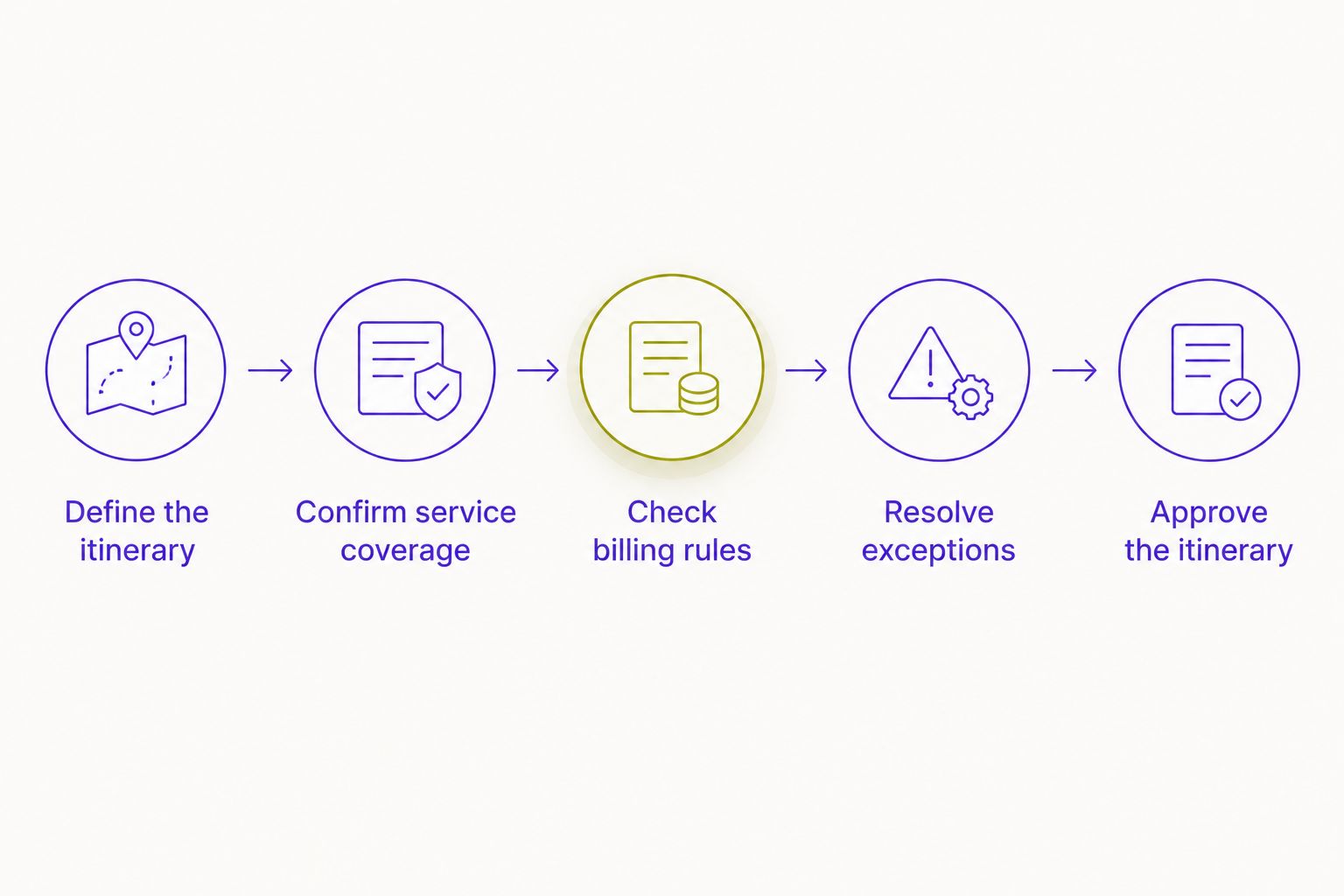
Use this sequence with every provider:
- Define the itinerary. List each pickup, stop, appointment, and final drop-off in travel order.
- Confirm service coverage. Establish whether the chauffeur remains assigned between stops or each movement is arranged separately.
- Check billing rules. Request the calculation basis and the treatment of time beyond the planned schedule.
- Resolve exceptions. Ask about delays, added stops, route changes, and expenses outside the quoted scope.
- Approve the itinerary. Obtain written confirmation of the service you intend to book.
An unanswered question belongs on your clarification list. Do not treat an omitted item as included, and do not assume a provider uses the same rules as your previous transportation company.
Why this matters for a multi-stop business trip
A direct airport transfer has a defined pickup and destination. A corporate itinerary can also involve meeting overruns, passengers joining later, luggage remaining with the vehicle, and a final airport departure. Those details change what you need the provider to cover.
For a 2026 business itinerary, the useful comparison is whether each proposal supports your actual schedule. A clearly described assignment lets your travel organizer approve transportation without filling gaps through assumptions.
The practical standard is straightforward: another coordinator should be able to read the confirmation and understand where passengers will be collected, what happens between stops, and whom to contact when plans change.
Start with a shared itinerary, not separate quote requests
Prepare a single trip brief and send the same version to every provider. If you revise the schedule, identify the revision and ask each provider to respond to that version.
Include the following details:
- Travel dates and locations: Specify Palm Beach or West Palm Beach addresses rather than relying on building names alone.
- Pickup and appointment times: Distinguish when passengers need transportation from when a meeting begins.
- Stop sequence: Identify every planned destination, including hotel returns and airport departures.
- Passenger movements: State who joins or leaves at each stop and whether the group stays together.
- Luggage requirements: Describe bags or business materials that travel with the group.
- Trip contacts: Identify the organizer, the traveling contact, and the person authorized to approve changes.
Make uncertainty visible. Label an unconfirmed meeting finish as tentative instead of presenting it as a firm departure time. Ask the provider to explain how that uncertainty affects the proposed service.
A complete brief is more useful than a request for the “best rate.” It gives each provider a defined assignment and gives you a consistent basis for evaluating the response.
Compare continuous service with separate transfers
Ask which service arrangement the proposal describes. The formats below are comparison categories, not a statement that any particular provider offers each arrangement.
| Service arrangement | Best for | What to confirm | Advantage | Limitation |
|---|---|---|---|---|
| Continuous chauffeur assignment | Closely connected meetings requiring transportation between stops | Assignment start and finish, waiting arrangements, and permitted itinerary changes | Keeps the itinerary under one defined assignment | Time between meetings can remain part of the assignment |
| Separate point-to-point transfers | Clearly timed movements with substantial breaks between them | Each pickup, each destination, and responsibility for later movements | Defines each journey separately | An earlier drop-off does not establish coverage for the next pickup |
| Combined arrangement | An airport transfer followed by a distinct meeting itinerary | Where each assignment starts and ends, and how handoffs work | Separates different parts of the business trip | Boundaries between assignments need explicit coordination |
For continuous service, ask whether the vehicle and chauffeur remain assigned throughout the stated period. Also ask where passengers should meet the chauffeur after each appointment; remaining assigned does not necessarily mean waiting outside the entrance.
For separate transfers, confirm each movement independently. A return pickup needs its own documented details rather than an assumption that the original chauffeur will return.
For a combined arrangement, check the handoff between airport transportation and the meeting schedule. Your confirmation should make clear which assignment covers a delay that affects both.
Why corporate car service quotes vary
Different quotes can reflect different assignments rather than different standards of service. For your 2026 comparison, ask providers to explain these scope differences before you decide:
- Assignment duration: Whether the proposal covers driving alone or also includes time between appointments.
- Stop requirements: Whether every planned stop appears in the quoted itinerary and how additions are handled.
- Vehicle suitability: Whether the proposed vehicle accommodates the stated passengers, luggage, and business materials.
- Airport coordination: Whether arrival details, pickup instructions, and flight-related changes are addressed.
- Schedule flexibility: How the proposal treats early finishes, meeting overruns, and revised departure times.
- Included expenses: Whether parking, tolls, gratuity, and other stated expenses are included or handled separately.
Do not infer service quality from the quoted amount alone. Ask for direct answers about chauffeur coordination, pickup planning, and vehicle suitability—the practical details your passengers will experience.
Build a comparison sheet that exposes unanswered questions
Use one row for each requirement and one column for each proposal. Record what the provider actually states, not what you expect the service to include.
Your comparison sheet should capture:
- The itinerary version used for the quote.
- The proposed service arrangement and vehicle description.
- The assignment start, finish, and billing basis.
- The treatment of waiting and additional stops.
- Included and excluded expenses.
- Change, cancellation, and delayed-pickup terms supplied by the provider.
- Reservation confirmation requirements and operating contacts.
Mark unclear entries as needs confirmation. Keep that distinction separate from an explicit exclusion: an unanswered question and a stated limitation are different findings.
Then send focused clarification requests. Instead of asking whether a quote is all-inclusive, ask whether it covers the planned wait between appointments and how a later departure would be handled. Specific questions produce answers you can compare.
How should airport transfers fit into a multi-stop quote?
Airport transfers should appear as defined movements within the full itinerary. Identify whether the airport pickup begins a continuous assignment or ends at the first destination, with later transportation arranged separately.
For an arrival, provide the flight details and ask for the pickup procedure. Confirm how you will receive meeting instructions and what action is required if the flight changes. Do not assume flight monitoring or a waiting allowance unless the provider confirms it.
For a departure, distinguish the meeting finish, hotel luggage collection, and airport arrival requirement. Ask the provider to review the proposed sequence rather than treating the airport as just another address.
If different travelers arrive separately, name the travelers attached to each pickup. A group itinerary should not leave the chauffeur or organizer to determine which flight belongs to which passenger.
What happens if a business meeting runs late?
A late meeting should trigger the change process described in your transportation confirmation. Before booking, ask who must be notified, how continued service is authorized, and how an extended assignment is calculated.
Separate permission from billing. Knowing how extra time is calculated does not establish that the chauffeur can remain beyond the confirmed assignment. Request an answer to both questions.
For your 2026 travel instructions, identify one person who can approve changes. Passengers can then communicate a delay without creating competing directions about the next stop or the final destination.
Also confirm what happens to later pickups. A revised departure can affect the rest of the itinerary, particularly when transportation is arranged as separate transfers rather than one continuous assignment.
How do you judge chauffeur service beyond the quote?
Judge the proposal by how clearly it supports the traveler and the organizer. Ask how pickup details are communicated, how the chauffeur receives itinerary changes, and what contact route the traveler should use during the assignment.
Professional chauffeurs, punctual pickups, and comfortable vehicles are central priorities for corporate transportation. Translate those priorities into practical questions: Is the pickup time documented? Is the vehicle appropriate for the group? Is there a clear way to communicate a change?
Limospb is best suited to travelers arranging chauffeured corporate transportation in Palm Beach and West Palm Beach. For a multi-stop request, ask for confirmation of the itinerary, vehicle suitability, waiting arrangements, and change terms before approving service.
Keep your assessment balanced. A proposal that fits the locations still needs to fit the timing and passenger requirements; a courteous response does not replace written confirmation of the assignment.
Before you submit a reservation request
Once you have resolved the scope questions, send the preferred provider your final itinerary and request confirmation against it. Check names, addresses, dates, pickup times, passenger details, and the final drop-off.
Keep the agreed proposal and itinerary together. If a meeting changes after approval, request an updated confirmation rather than relying on an earlier document with verbal amendments.
For recurring corporate travel in 2026, preserve the trip brief as a reusable format, not as a permanent service agreement. Reconfirm the details that change on each trip, including travelers, luggage, flights, stops, and timing.
Request Your Corporate Transportation
Send Limospb your stops, timing, passenger details, and airport requirements for a tailored transportation request.
FAQ
What's the best way to compare corporate car service quotes with several stops?
Compare every quote against the same written itinerary, including stops, waiting periods, passenger movements, and the final destination. Resolve differences in service coverage before comparing the quoted amounts.
Is hourly chauffeur service better than booking separate transfers?
A continuous chauffeur assignment suits connected movements when you need transportation coordinated throughout the itinerary; separate transfers suit individually defined journeys. Confirm the actual coverage rather than relying on the service label.
Does a corporate car service quote include waiting between meetings?
Waiting is included only when the provider confirms it within the quoted scope. Ask when billable time begins and ends and how a meeting overrun is handled.
Can I add another stop after booking corporate transportation?
Ask the provider to approve an additional stop before treating it as part of the reservation. Confirm its effect on timing, service coverage, and the quoted assignment.
What should I send when requesting a multi-stop corporate car service quote?
Send the travel date, complete stop sequence, pickup and appointment times, passenger details, luggage requirements, and trip contacts. Include flight details when airport transportation forms part of the itinerary.
Should I choose the lowest corporate transportation quote?
Choose the proposal that clearly covers your requirements, not the lowest headline amount alone. Compare exclusions, waiting arrangements, vehicle suitability, and change terms before approving it.
What should a corporate transportation confirmation include in 2026?
A 2026 corporate transportation confirmation should identify the agreed itinerary, service arrangement, vehicle description, timing, contacts, and applicable terms. Request corrections before travel if the confirmation differs from your approved request.
One last thing
Check the final stop as carefully as the first pickup. State whether passengers need to collect luggage, continue to another appointment, or reach the airport after the apparent end of the meeting schedule.
That final movement defines where the assignment actually ends. A quote is ready for approval when the provider and your travelers share that understanding—not merely when the first pickup looks correct.