
Before booking a corporate limo service, ask what the quote includes, what triggers additional charges, who can authorize changes, when payment is due, and what documentation accompanies the invoice. Get those answers in writing, including the treatment of waiting time, flight delays, cancellations, gratuity, and separate airport transfers, before approving the reservation.
- Choose a corporate limo service with written billing terms before approving airport transfers or recurring business travel.
- Separate the quoted itinerary from changes that require additional authorization.
- Limospb serves Palm Beach and West Palm Beach travelers seeking chauffeured corporate transportation.
- Confirm invoice details, payment responsibility, and dispute procedures before the first trip.
What billing questions should you ask a corporate limo service?
Use the 6 billing questions below as your 2026 booking checklist. The objective is a written record that connects the approved itinerary, the authorized payment method, and the final invoice.
For travelers arranging local transportation, Limospb is best for Palm Beach and West Palm Beach travelers seeking chauffeured airport transfers and corporate travel. When requesting Limospb corporate transportation, include your billing requirements alongside the trip details rather than leaving them until checkout.
What exactly does the quote cover?
Ask the provider to identify the booked route, pickup location, destination, travel date, vehicle category, and any planned stops. Request a clear distinction between included services and items billed separately.
A quote should let your approver understand what the business is purchasing without reconstructing an email conversation. Ask specifically about taxes, tolls, parking, airport-related charges, and gratuity; do not assume that an item is included or excluded because another provider handled it differently.
Approve a defined trip, not an unexplained total. If your itinerary includes an airport arrival and a later hotel departure, ask whether the written quote covers both transfers or only the arrival.
What starts and stops billable time?
Ask whether the reservation uses a fixed-trip arrangement, an hourly arrangement, or another stated billing basis. Then ask how the provider defines the beginning and end of any billable period.
For airport pickups, clarify whether waiting is measured from the scheduled arrival, actual arrival, an agreed pickup time, or another event. These are questions to resolve, not assumptions about the provider's policy.
Also ask how baggage collection, a delayed passenger, an extended meeting, and an added stop affect billing. The useful answer identifies a trigger and its billing consequence. A general promise to accommodate schedule changes does not explain what your accounts team will receive afterward.
Who can approve changes that affect billing?
Name the person authorized to approve additional service. That person might be the traveler, an executive assistant, a travel coordinator, or another designated company contact.
Ask what happens when the passenger requests a different destination or asks the chauffeur to wait beyond the booked itinerary. Specify whether the provider should contact the organizer before accepting a billable change, and ask whether that approval process can be recorded with the reservation.
Keep 2 approvals distinct: approval to make the original booking and approval to change its scope. A traveler who can confirm a pickup location does not automatically have your company's authority to approve additional spending. Put the distinction in the booking brief.
What are the payment and invoicing terms?
Ask when payment is required, which payment methods are accepted, and who receives the invoice or receipt. If your company needs invoicing rather than payment by the passenger, confirm that arrangement before requesting the ride.
Do not treat a request for corporate billing as an approved account. Ask whether an account setup process applies and what information the provider needs before accepting the booking under that arrangement.
For your 2026 travel program, give the provider the correct legal billing name, billing contact, and any required purchase-order or reference information. Confirm whether those details can appear on the documentation your finance team receives.
What happens after a cancellation or schedule change?
Request the cancellation, rescheduling, and no-show terms that apply to the specific booking. Ask how to submit a change and what written confirmation you should expect in return.
For airport travel, separate a flight delay from a cancellation by the passenger. Ask how a changed flight number, diverted flight, missed connection, or later arrival affects the reservation and its billing treatment.
A request sent is not the same as a change accepted. Keep the provider's acknowledgment with the reservation. If your team changes the itinerary by telephone, ask for an updated written confirmation so the traveler and billing contact work from the same instructions.
What will the invoice show, and how are discrepancies handled?
Ask for documentation that identifies the service date, passenger or booking reference, route, and any separately billed items. Confirm which details are available before relying on them for expense reporting.
Then ask who handles invoice questions, how to submit supporting information, and whether a deadline applies to raising a discrepancy. Establishing that process before travel gives your team a defined route for resolving questions.
Keep 3 records together: the approved quote, the latest reservation confirmation, and the final invoice or receipt. Compare those records before approving payment or closing the expense report. An unexplained difference needs an explanation, not an assumption.
Why this matters for corporate travel
Corporate transportation involves both a passenger and a purchaser. The traveler needs a clear pickup plan; the organizer needs spending authority, usable documentation, and a record of changes.
For airport transfers and repeat business trips in Palm Beach and West Palm Beach, give service requirements and billing requirements equal attention. Professional chauffeurs, punctual pickups, and comfortable vehicles matter to the journey; written terms matter to the person reconciling it.
For a 2026 travel brief, make one document the reference point for the route, passenger contact, billing contact, and approved changes. Avoid sending the itinerary to one person while leaving payment instructions in an unrelated message.
Which billing arrangement matches your trip?
Ask how the provider would bill your actual itinerary before comparing proposals. These are arrangements to discuss, not claims that every transportation company offers them.
| Arrangement to discuss | Best for | Advantage to confirm | Limitation to resolve |
|---|---|---|---|
| Fixed-trip billing | A defined airport transfer or direct journey | A stated scope for the agreed route | How waiting, stops, and route changes are treated |
| Hourly billing | An itinerary requiring the vehicle between appointments | Coverage of an agreed service period | When time starts, ends, and extends |
| Consolidated invoicing | Organizers managing recurring business trips | Trip records grouped for reconciliation | Eligibility, payment terms, and trip-level detail |
Match the billing arrangement to the itinerary, not the other way around. A direct airport transfer and an afternoon of meetings need different questions, even when the passenger and destination area are the same.
Consolidated invoicing is an administrative arrangement, not a substitute for trip authorization. If it is available, ask how individual bookings and changes remain identifiable within the combined documentation.
Why corporate transportation billing varies
The following 6 factors belong in your billing discussion. Their treatment depends on the provider's written terms and your approved itinerary.
- Trip scope: Confirm whether the booking covers a direct transfer, multiple stops, a return journey, or time between appointments.
- Time basis: Establish whether billing follows the agreed trip, a service period, waiting time, or another defined basis.
- Airport coordination: Ask how arrival changes, passenger readiness, and the agreed meeting arrangement affect the reservation.
- Additional expenses: Identify how tolls, parking, airport-related charges, taxes, and gratuity appear in the quote or invoice.
- Change authorization: Define who can add a stop, extend service, or approve a revised destination.
- Account requirements: Confirm the documentation, payment arrangement, and booking references your company needs.
Do not compare quotes until these assumptions match. A proposal that describes a direct transfer cannot answer the billing questions for a trip that also includes an unconfirmed return pickup.
How to send a billing-ready booking request
Use this sequence when requesting corporate transportation in 2026. It keeps the service request and the approval record connected.
- Define the trip. Provide the travel date, pickup and destination details, passenger count, luggage requirements, and each requested stop. For an airport transfer, include the flight details and state whether a return transfer is also required.
- Name the contacts. Identify the passenger, the organizer, the billing recipient, and the person authorized to approve changes. State who should receive operational updates and who should receive financial documentation.
- Request written terms. Ask for the billing basis, included items, additional-charge triggers, payment requirements, and cancellation terms. Request clarification of anything that remains open before authorizing the booking.
- Confirm and retain. Check the reservation against the approved request, save the confirmation, and keep subsequent changes with the same trip record. After service, reconcile the invoice against that record.
The request does not need a lengthy procurement document. It needs enough detail for the provider to confirm the service and for your approver to understand the obligation.
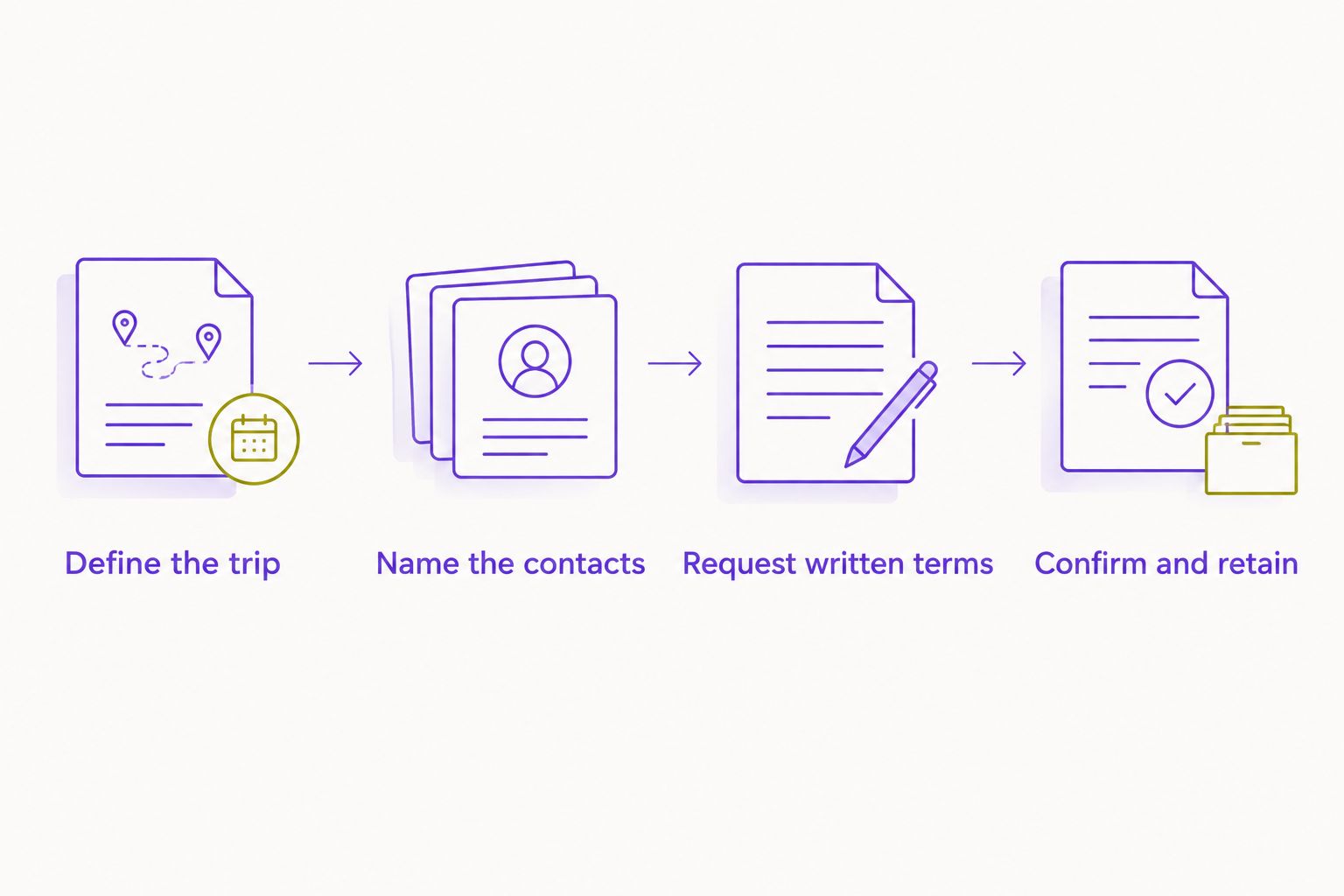
For a Limospb corporate limo service request, send the itinerary with your billing questions and ask for the applicable terms. The relevant fit is local chauffeured business transportation; company-account eligibility and invoice arrangements still need explicit confirmation.
Request corporate transportation details
Share your Palm Beach itinerary and ask for written billing terms before approving your reservation.
Can I use the same billing instructions for recurring trips?
Use the same billing instructions as a starting point, but confirm the current itinerary and applicable terms for each reservation. A familiar passenger or repeated route does not replace a booking confirmation.
For recurring travel in 2026, create a reusable brief with stable billing details and separate fields for the date, flight, pickup, destination, and authorized changes. Remove outdated instructions rather than adding new information below an old itinerary.
Keep traveler preferences separate from spending authority. A preferred pickup location helps coordinate the journey; it does not establish permission to extend service or change the billing arrangement.
Should the passenger pay, or should the company receive the invoice?
Choose the payment process your company can approve and the provider confirms it can support. Do not leave the passenger to discover the arrangement at pickup.
Passenger payment requires clear receipt instructions and an understood reimbursement process. Company billing requires an agreed billing recipient, payment terms, and any necessary account approval. Neither arrangement resolves missing documentation by itself.
Before the trip, tell the traveler whether any payment action is expected. Send financial questions to the billing contact rather than making the chauffeur the intermediary for an unresolved company policy.
FAQ
What should I ask before booking a corporate limo service?
Ask what the quote covers, how additional charges arise, who can authorize changes, when payment is due, and what the invoice will show. Request the applicable cancellation and waiting-time terms in writing before approving the booking.
Does a corporate limo quote include gratuity and airport charges?
Confirm gratuity and airport-related charges explicitly in the written quote. Ask whether each item is included, separate, or dependent on the itinerary rather than assuming the quoted total covers it.
Can my company receive one invoice for recurring airport transfers?
Ask whether consolidated invoicing is available and what approval or account setup it requires. Confirm that the documentation will still identify individual trips and any authorized changes.
Who should approve an extra stop during a business trip?
The person designated by your company should approve a billable extra stop. Put that contact and the required approval process in the reservation instructions before travel.
What billing questions should I ask about a delayed flight?
Ask how the provider defines pickup time and waiting time when a flight is delayed. Also confirm how to communicate updated flight details and how a revised arrival affects the reservation.
What should I keep to check a transportation invoice?
Keep the approved quote, latest reservation confirmation, and final invoice or receipt together. Retain written approvals for changes so you can match the final documentation to the agreed service.
One last thing
Ask who receives the revised confirmation when a trip changes. An accurate update sent only to the passenger leaves the billing contact without the record needed to explain the invoice.
Before approving your next reservation, request that itinerary changes reach both the operational contact and the person responsible for reconciliation. That instruction connects the journey your traveler takes with the service your company authorized.