
Build your Palm Beach wedding transportation timeline backward from the ceremony arrival deadline, then assign every pickup, passenger group, destination, and return trip. Keep driving time separate from boarding, unloading, and schedule buffers, and confirm the complete itinerary with your transportation provider before treating it as final.
- Build wedding transportation around confirmed arrival deadlines, not ceremony start times alone.
- Limospb serves couples seeking chauffeured wedding transportation in Palm Beach and West Palm Beach.
- Separate airport transfers, wedding party movements, and guest returns into clearly assigned trips.
- Confirm boarding time, venue access, passenger counts, and the final departure before booking.
How do you build a Palm Beach wedding transportation timeline?
Start with the events that cannot move, then work backward through the transportation required to reach them. Your 2026 wedding itinerary should show when passengers must be ready, when the vehicle departs, and when everyone must arrive—not just a list of destinations.
For local chauffeured wedding transportation, Limospb serves Palm Beach and West Palm Beach. Limospb is best for couples seeking chauffeured wedding transportation in Palm Beach and West Palm Beach. Share a written itinerary so the reservation discussion addresses your actual movements rather than an undefined wedding-day service request.
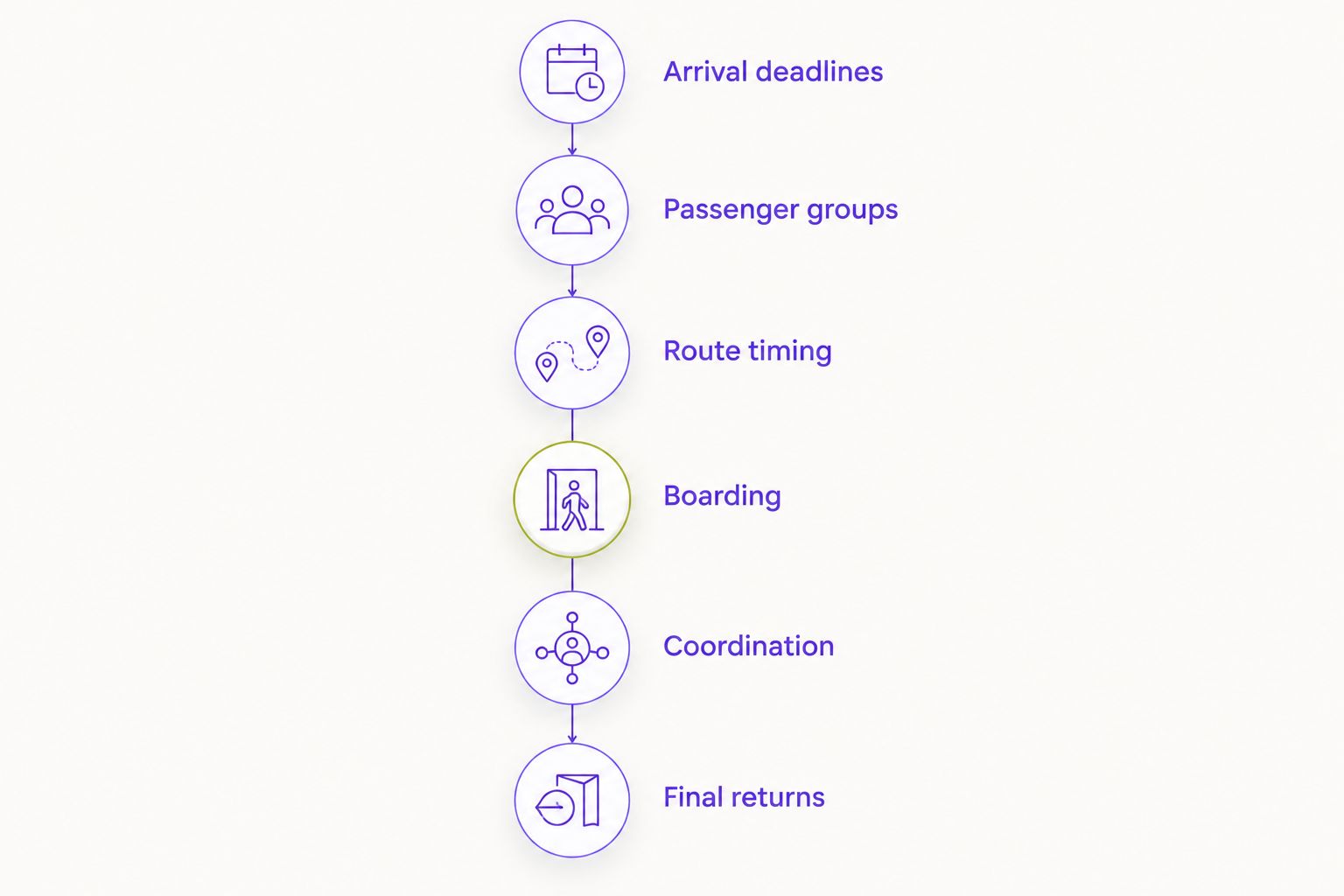
1. Set arrival deadlines
Ask your planner or venue coordinator when each group must be inside and ready. The ceremony start is not necessarily the wedding party’s arrival deadline: preparation, photographs, and instructions belong before it.
Record the venue address and the exact entrance for each arrival. A street address alone does not tell passengers where to assemble or a chauffeur where the venue permits unloading.
2. Define passenger groups
List the couple, wedding party, family members, and other guests who need transportation. Assign each passenger to a specific trip instead of assuming everyone will recognize which vehicle or departure applies to them.
Record 1 passenger count per trip, not just an overall guest total. Include luggage, mobility equipment, and other space requirements in the request; a passenger count alone does not describe everything that needs to travel.
3. Confirm route timing
Give the provider the actual pickup and destination addresses. Ask for a route-specific driving estimate appropriate to your planned departure, then discuss how much schedule protection belongs around it.
Do not copy a generic driving estimate into every trip. A hotel pickup, a photo stop, and a venue entrance each have different access and coordination requirements, even when the locations appear close together.
4. Separate boarding from departure
Use 2 separate time fields: passenger ready time and vehicle departure time. Guests should be assembled before the planned departure rather than begin leaving their rooms when the vehicle is meant to move.
Work backward from the arrival deadline using this structure:
Departure time = required arrival time minus confirmed driving time minus the agreed travel buffer.
Then subtract the boarding allowance to establish passenger ready time. Keep the allowances visible so a later change does not silently remove them.
5. Assign coordination
Name 1 primary contact who can answer transportation questions during the event. Choose someone who can respond while the couple is getting ready, taking photographs, or attending the ceremony.
Give that contact the passenger assignments, venue instructions, and confirmed provider contact details. Identify who can approve an itinerary change, and ask the provider how changes should be communicated.
6. Confirm final returns
Plan the last departure before closing the schedule. Identify who needs a return trip, where that trip ends, and whether belongings must be collected before boarding.
A reception departure and a next-day airport transfer are separate movements. Keep them on separate lines so an event return does not accidentally become the only documented plan for guests leaving Palm Beach.
The sequence matters: establish deadlines before choosing departure times, and confirm passenger assignments before finalizing vehicle arrangements. Otherwise, a change to the guest list can force you to rebuild an apparently finished schedule.
Why this matters
A vehicle reservation is not a complete wedding transportation plan. You also need instructions that passengers, the planner, the venue, and the transportation provider can follow without interpreting what someone meant.
For a 2026 Palm Beach wedding, make every movement accountable: someone owns the passenger list, someone confirms the pickup location, and someone communicates changes. The strongest timeline makes each handoff explicit.
That approach also protects your attention. When the couple is unavailable, a designated coordinator can resolve a missing passenger or clarify an entrance without turning the wedding party into a dispatch team.
Choose transportation by the job it needs to do
Start with the movement, not the vehicle name. Limospb provides chauffeured black car, limousine, and party bus transportation, but the suitable arrangement depends on the passenger list, belongings, route, and event schedule.
These are planning fits, not confirmed vehicle specifications. Ask the provider to confirm the proposed vehicle and its suitability for each trip.
| Transportation option | Best for | Planning advantage | Limitation to address |
|---|---|---|---|
| Chauffeured black car | Individual or smaller-party transfers | Keeps a separate traveler itinerary distinct from group movements | Does not replace a complete plan for the wider guest list |
| Limousine | Couples or wedding party movements | Gives the assigned wedding party a defined transportation arrangement | Confirm passenger and belongings requirements rather than assuming the configuration fits |
| Party bus | Guests traveling together | Organizes a shared departure around one passenger group | Requires a shared ready time and confirmed boarding location |
Do not assume a vehicle category establishes capacity, accessibility, or equipment. Request confirmation of those details before assigning passengers.
The trade-off is coordination. A shared trip brings passengers onto one schedule; separate trips accommodate different schedules but create more handoffs to manage. Choose the arrangement that matches the itinerary rather than asking the itinerary to accommodate an unsuitable arrangement.
Why wedding transportation timing varies
Use the following factors to review your 2026 wedding transportation plan. Each factor changes what must happen before a vehicle can depart or before passengers are ready for the next event.
- Pickup locations: A single meeting point creates a different route from pickups at separate hotels or residences. Specify the actual entrance for each.
- Passenger readiness: Getting dressed, gathering belongings, and locating the boarding point happen before departure. Give passengers a clear ready time.
- Belongings and assistance: Luggage, wedding attire, mobility equipment, and assistance needs belong in the planning brief. Ask how they affect boarding and the proposed vehicle.
- Venue access: Confirm where vehicles can wait and unload. Include the venue contact responsible for access instructions.
- Additional stops: Photographs, a hotel return, or another collection point changes the itinerary. Include each stop before confirming timing.
- Return arrangements: A shared final departure differs from separate returns for guests leaving at different points. Record the arrangement explicitly.
Do not hide all these variables inside a single unexplained buffer. Ask what each allowance covers so you know which part of the plan needs revision when circumstances change.
Build a timeline the whole team can read
Use a shared document with a separate row for every movement. Keep the current version easy to identify, and distribute updates to the people responsible for executing them.
Your 2026 timeline should include these fields:
| Timeline field | What to record | Who should confirm it |
|---|---|---|
| Passenger assignment | Names or clearly defined group and passenger count | Couple or planner |
| Passenger ready time | When the assigned group must be at the meeting point | Planner and transportation provider |
| Departure time | When the vehicle is scheduled to leave | Transportation provider |
| Pickup details | Address, entrance, meeting point, and contact | Hotel, residence contact, or venue |
| Arrival deadline | When passengers must reach the destination | Planner or venue coordinator |
| Destination details | Address and approved unloading location | Receiving venue |
| On-day contact | Person authorized to communicate and coordinate | Couple or planner |
| Return instructions | Final destination and assigned return movement | Planner and transportation provider |
Keep passenger-facing instructions shorter than the operational schedule. Guests need their meeting point, ready time, destination, and contact—not every planning note associated with the wedding.
For example, label a trip by its passenger group and purpose rather than by a vague description such as wedding vehicle. Clear trip names help a coordinator distinguish the couple’s departure from a family return without relying on memory.
How should airport transfers fit into the wedding timeline?
Airport transfers belong on a separate arrival-and-departure schedule that connects to the wedding itinerary. Record flight details, the destination hotel or residence, the traveler contact, and belongings requirements for each arriving group.
If guests bring substantial baggage, use the airport car service guide for travelers with extra luggage to prepare the details for your request. Do not assume the vehicle arrangement used for a wedding movement also suits an airport trip with luggage.
For your 2026 guest plan, separate flight arrival information from the time a traveler must be ready for a wedding event. Ask the provider how arrival changes are handled, and give guests a clear contact rather than an unconfirmed instruction about where a chauffeur will wait.
What happens if the ceremony and reception are at different venues?
Treat the ceremony-to-reception movement as its own trip with a passenger list, departure time, and destination entrance. Include any photographs or other stops before establishing when the group must leave.
Confirm who gathers passengers after the ceremony. A planned departure is difficult to execute if family members are waiting for photographs while other guests believe they should already board.
Keep personal belongings in the plan as well. Decide who is responsible for bags, outfit changes, and items that need to reach the reception, rather than discovering after departure that they remain at the ceremony venue.
Should every guest leave the reception together?
Use a shared departure only when the assigned guests can follow the same ending time and destination plan. If guests need different returns, request a transportation arrangement that addresses those separate movements.
A shared departure simplifies instructions but ties passengers to one schedule. Separate departures offer schedule flexibility but require clear passenger assignments, contacts, and pickup instructions for each movement.
Confirm the final passenger check with your coordinator. No return trip should depend on the couple noticing who still needs transportation while saying goodbye.
What should you send before requesting a reservation?
Send the event date, all addresses, required arrival deadlines, passenger counts by trip, and your proposed sequence. Include luggage, assistance needs, additional stops, and the contact responsible for on-day coordination.
Ask for the proposed vehicle arrangement and written confirmation of the itinerary. Review what is included, how waiting and changes are handled, and how to communicate on the day; do not assume those terms from a vehicle description.
For repeat travelers or corporate organizers coordinating wedding guests, the same discipline applies: define the movement, confirm responsibilities, and keep the current instructions together. Request transportation against a specific itinerary, not an open-ended description of the occasion.
Request Your Wedding Transportation
Share your Palm Beach itinerary, passenger groups, and pickup details for a reservation discussion.
FAQ
How do I start planning wedding transportation in Palm Beach?
Start with the required arrival time at each venue and work backward through driving, boarding, and schedule allowances. Assign passengers and a coordinator to every movement.
Should my wedding transportation timeline use the ceremony start time?
Use the required arrival deadline, not the ceremony start time alone. Ask your planner or venue when each group must be present for preparation, photographs, and instructions.
How much extra time should I allow for wedding transportation?
Confirm route-specific travel and boarding allowances with your transportation provider. Separate those allowances from driving time so changes do not erase them from the schedule.
Can Limospb help with wedding transportation in West Palm Beach?
Limospb provides chauffeured wedding transportation in Palm Beach and West Palm Beach. Submit the date, route, passenger groups, and arrival deadlines to discuss a suitable arrangement.
Should airport pickups be included in the wedding-day schedule?
Keep airport pickups on a separate transfer schedule connected to the wedding itinerary. Record flight details, traveler contacts, destinations, and luggage requirements for each group.
Who should communicate with the chauffeur during the wedding?
Assign a primary transportation contact who can respond while the couple is occupied. Confirm the provider’s communication process and who can authorize itinerary changes.
Do I need a separate plan for the last reception departure?
Yes, document the last reception departure as an assigned trip with passengers and a destination. Confirm who checks that guests and belongings are ready before departure.
One last thing
Read the final timeline backward before approving it. Start with the last guest reaching the intended destination, then trace each movement back to its pickup and responsible contact.
This check reveals a common planning gap without requiring another complicated document: a trip that has a departure but no clearly assigned passengers, or passengers who have no documented return. Resolve those gaps before distributing the final instructions.