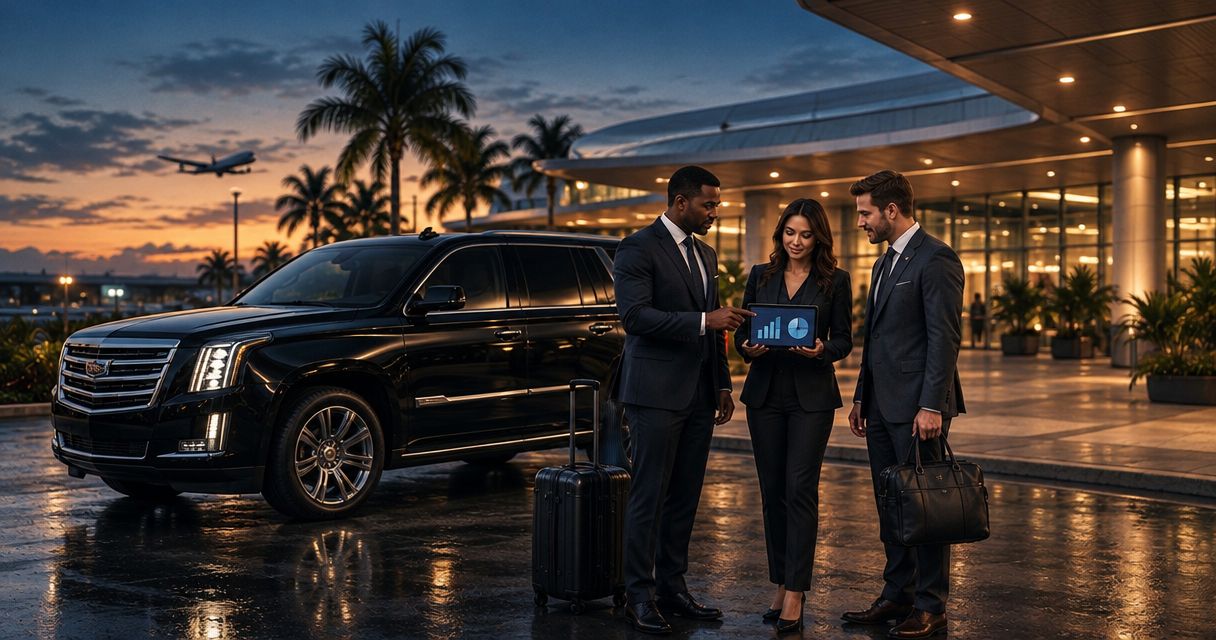
Conference speaker transportation is a corporate limo service coordinated around flights, rehearsals, and stage times to get presenters to their event commitments. For a West Palm Beach conference in 2026, the booking needs to account for more than the airport transfer: hotel departures, venue access, presentation materials, and the person authorized to change the itinerary all matter.
- Limospb corporate limo service suits conference organizers arranging chauffeured transportation in West Palm Beach.
- Plan airport transfers, hotel departures, and venue arrivals as separate trip legs.
- Work backward from the speaker’s required arrival, not the published session time.
- Confirm pickup instructions, luggage needs, and change procedures before submitting a reservation request.
Why corporate limo service matters for conference speakers
A conference speaker has a fixed commitment at the destination, not just a preferred arrival time. Missing a hotel check-in window is different from missing a sound check, moderator briefing, or presentation. Your transportation plan must connect those commitments without treating them as interchangeable destinations.
Limospb corporate limo service is best for conference organizers arranging chauffeured travel in West Palm Beach. Limospb provides black car and limousine transportation for airport transfers and corporate travel in the Palm Beach area. Professional chauffeurs, punctual pickups, and comfortable vehicles are the customer-confirmed reasons to consider the service; the specific itinerary still needs confirmation.
For your 2026 event, build the request around the speaker’s obligations rather than a preferred vehicle appearance. A useful brief tells the transportation provider where the speaker must be, when the speaker must be ready, and who handles changes. It also gives your event team a clear handoff instead of leaving transportation details scattered across email threads.
How to arrange transportation around a speaker’s schedule
1. Map every required trip leg
Start with a shared document or spreadsheet. Separate the airport arrival, hotel-to-venue journey, and return airport transfer into 3 trip legs when that matches the itinerary. Add sponsor dinners or rehearsals as distinct movements rather than burying them in a general event note.
For each leg, distinguish the pickup time from the required destination arrival. A speaker arriving at the venue still needs to reach the correct room and meet the event contact. Ask the conference team what happens between the vehicle drop-off and the stage appearance, then include that requirement in the brief.
Keep personal plans separate from event-authorized transportation so the booking contact knows which movements require approval.
- Record the date and local time for each movement.
- Enter the full pickup and destination addresses.
- Identify rehearsals, briefings, and presentation commitments.
- Mark each trip leg as requested or confirmed.
- Name the person responsible for approving additions.
2. Build pickup requests backward from event commitments
Use the event schedule to establish the required venue arrival first. Then ask the transportation provider to advise on the departure time for the actual route and date. Do not substitute a generic airport-to-downtown estimate for a hotel departure, venue entrance, or conference loading area.
For your 2026 conference, keep the session start and speaker check-in as separate calendar entries. If the event team has not specified a check-in time, obtain one before finalizing transportation. This prevents an apparent on-time drop-off from becoming a late backstage arrival.
Limospb can be considered for the chauffeured travel portion of this plan; submit the complete schedule rather than asking the provider to infer the conference’s internal requirements.
- Confirm the speaker’s required venue arrival.
- Obtain the rehearsal or sound-check schedule.
- Ask for route-specific departure guidance.
- Identify the permitted passenger drop-off entrance.
- Keep event check-in separate from session start.
3. Match the vehicle request to passengers and equipment
Create a passenger and luggage list manually before discussing the vehicle. A speaker traveling alone with presentation materials has different requirements from a presenter accompanied by an assistant, colleague, or family member. Describe what needs transporting rather than assuming a vehicle category guarantees enough space.
Include bulky cases, display materials, and any equipment that must stay with the traveler. Ask whether the proposed vehicle accommodates the complete load, and request confirmation of any accessibility or assistance needs. A vehicle label alone does not settle those questions.
Choose the vehicle around the trip requirements, not the photograph. The relevant comparison is whether the proposed arrangement fits the passengers, belongings, and venue access requirements together.
- List all passengers on each trip leg.
- Describe suitcases and oversized items.
- Identify presentation equipment that travels with the speaker.
- State accessibility or boarding requirements.
- Ask the provider to confirm the proposed vehicle’s suitability.
4. Assign ownership of airport and venue handoffs
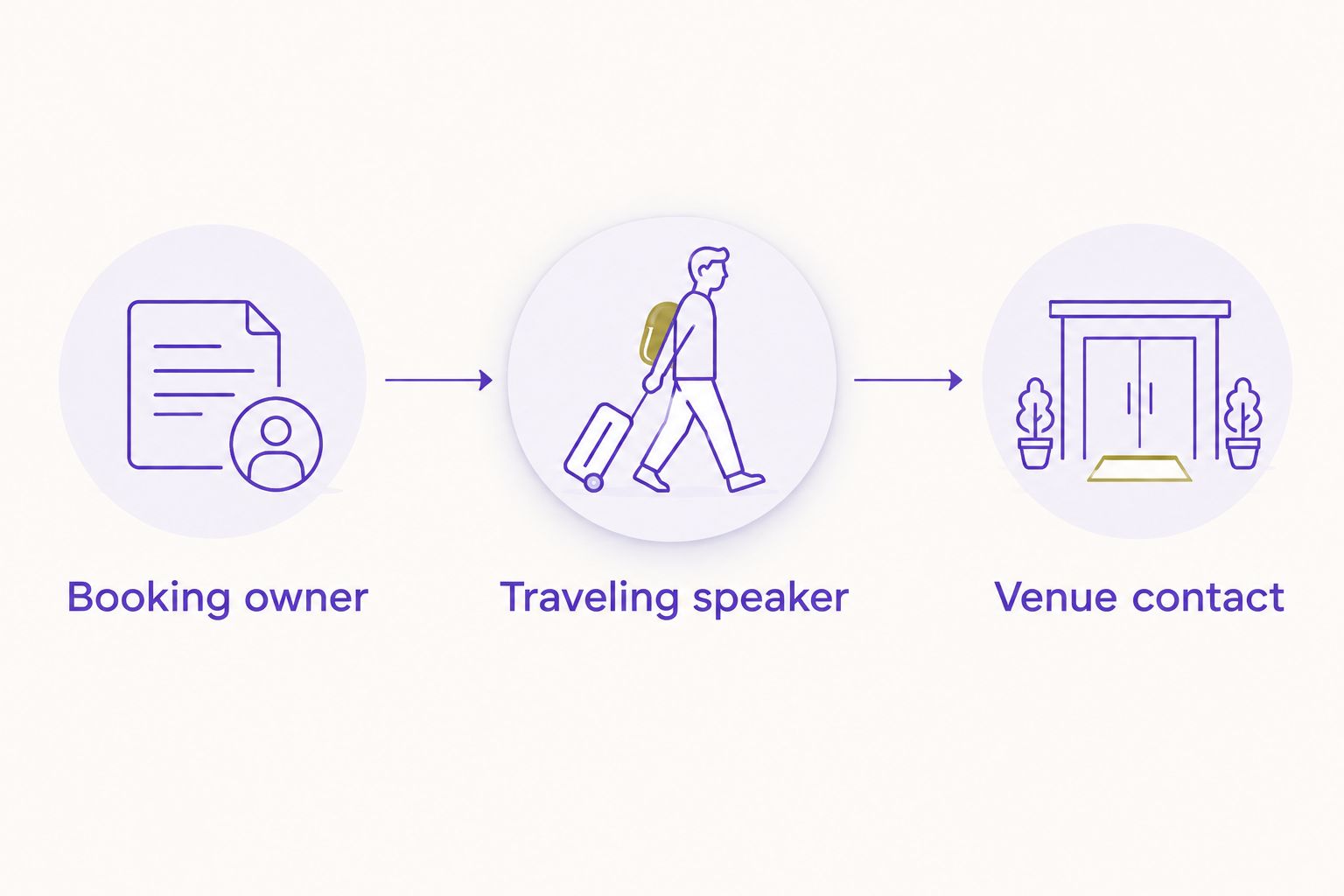
Set 1 booking owner and identify 2 operational contacts: the traveling speaker or accompanying assistant, and the conference’s on-site coordinator. These are planning recommendations, not service requirements. The goal is to prevent conflicting instructions when an arrival changes or a session runs late.
Use a simple handoff sequence: the booking owner maintains the itinerary, the traveler follows the confirmed pickup instructions, and the venue contact handles the destination arrival. Ask the provider how transport-related updates should reach the appropriate person.
The following handoff map keeps responsibility visible. It does not replace the provider’s confirmed pickup process or the conference’s own arrival instructions.
- Give the booking owner control of the master itinerary.
- Supply the traveler’s working mobile contact.
- Identify the venue contact and meeting location.
- Ask how to communicate a changed flight or destination.
- Distribute the same confirmed instructions to everyone involved.
5. Confirm airport pickup and schedule-change procedures
Review the flight details against the reservation request, including the arrival date. An overnight journey can put departure and arrival on different calendar days. For an airport pickup, ask where the traveler should go after collecting luggage and how the traveler receives the meeting instructions.
For 2026 travel, obtain the provider’s current procedures directly. Do not assume flight tracking, waiting arrangements, meet-and-greet service, or automatic rescheduling are included. A delayed inbound flight and a speaker extending a meeting are different changes; ask how each should be communicated.
The guide to how flight delays affect a Palm Beach airport car reservation addresses a related planning question. Keep the actual provider’s written confirmation with the itinerary.
- Verify the airline, flight number, and arrival date.
- Request the precise airport meeting instructions.
- Ask about delayed arrivals and changed flights.
- Clarify waiting and additional-stop terms.
- Confirm how to report changes outside the original itinerary.
6. Separate the transportation request from the event agenda
Send a concise transportation brief rather than forwarding the entire conference program. A calendar invitation or spreadsheet works for preparing it. The provider needs actionable journey details; the speaker needs a readable itinerary without internal planning discussion.
Include the airport transfer, hotel departure, venue destination, and return movement in the request to Limospb. Ask for confirmation against those details before treating the booking as settled. For recurring corporate travel, retain the useful passenger preferences but recheck dates, flights, addresses, and passenger counts for each journey.
Keep sensitive presentation content out of the transport brief. The relevant information is what affects the movement, not what the speaker plans to say on stage.
- Put each requested movement on its own line.
- Include passenger names and operational contacts.
- State luggage and accessibility requirements.
- Distinguish confirmed details from unresolved questions.
- Request written confirmation of the agreed itinerary.
7. Reconcile the return trip before the event begins
Plan the departure journey while the arrival details are still being organized. The speaker’s final session is not necessarily the final obligation: audience questions, an organizer debrief, or collecting materials can affect when the traveler is ready to leave. Ask the event contact which obligations are actually scheduled.
Build the airport departure around the traveler’s airline guidance and the provider’s route advice. Do not reuse the inbound journey duration as a guaranteed return estimate. If the speaker leaves from the venue rather than the hotel, include any luggage collection stop explicitly.
Finish by reconciling the traveler’s copy with the booking owner’s copy. A confirmed arrival transfer does not establish a return reservation. Check each movement separately.
- Confirm the final scheduled event obligation.
- Identify where luggage will be collected.
- Specify the return pickup address and entrance.
- Check the departure flight and travel date.
- Verify that the return movement has its own confirmation.
Compare transportation options for conference speakers
Choose the arrangement that matches the speaker’s commitments and your team’s ability to coordinate them. Start with the itinerary, then compare the advantages and limitations below. None of these options removes the need to verify venue access or communicate schedule changes.
| Option | Best for | Practical advantage | Key limitation |
|---|---|---|---|
| Limospb corporate limo service | Organizers requesting chauffeured airport and corporate travel in West Palm Beach | Combines the requested journey with a professional chauffeur and an agreed itinerary | Vehicle suitability, pickup instructions, and change terms require confirmation |
| App-requested rides | Travelers arranging individual journeys themselves | Lets the traveler initiate each ride request | The organizer must account for when and how each request is made |
| Rental car | Speakers who want to drive between commitments | Gives the traveler direct control of their movements | The speaker also handles driving, parking, and vehicle return |
| Organizer-arranged group transport | Speakers traveling together on a shared event schedule | Keeps a group’s transportation coordinated | Individual flights and rehearsals must fit the shared departure plan |
A chauffeured arrangement suits an organizer who wants to establish the trip details before the traveler arrives. Its limitation is that an incomplete brief still produces unanswered questions. App-requested rides and rental cars put more execution in the traveler’s hands, while group transport requires you to reconcile several people’s schedules.
For an individual keynote speaker with a separate airport arrival and rehearsal, request an individual itinerary first. For speakers arriving together, compare a shared arrangement only after checking passengers, luggage, and destinations. Do not assume that a group option serves different flights or venue commitments equally well.
Request your speaker transportation
Send the itinerary, passenger details, and venue requirements for your West Palm Beach conference.
Common mistakes conference organizers make
Booking against the session start
A published session time is not a transportation arrival target. Ask the program team when the speaker must report for preparation, then use that time in the request. Keep the conference room and vehicle drop-off entrance distinct: an address alone does not tell the traveler where to meet the event contact.
Treating a calendar invitation as a confirmed reservation
A calendar entry records your plan; it does not establish what the transportation provider accepted. Check the provider’s confirmation against the itinerary, including the date, route, passengers, and return movement. Resolve mismatches before sharing the final schedule with the speaker.
Sending changes through several people
When a speaker, assistant, and event manager all send separate updates, the current instruction becomes unclear. Route changes through the named booking owner and have that person redistribute the accepted revision. For urgent changes, use the communication procedure agreed with the provider rather than relying on an unacknowledged email.
Omitting the stop between venue and airport
A return request can overlook luggage left at the hotel. State the hotel stop and confirm it as part of the route instead of expecting the chauffeur to add it informally. Apply the same discipline to equipment collection, a dinner venue, or another scheduled destination.
Choosing by vehicle category before checking requirements
A limousine request does not explain how many people are traveling, what they are carrying, or which venue entrance they need. Supply those details first. Ask the provider to recommend and confirm a suitable arrangement rather than assuming the category name answers every practical question.
FAQ
What’s the best corporate limo service arrangement for a conference speaker?
The best arrangement matches the speaker’s flights, required venue arrival, passengers, and luggage. For a West Palm Beach event, request each airport, hotel, and venue movement separately so the provider can confirm the complete itinerary.
How early should a conference speaker arrive at the venue?
Use the arrival time specified by the conference’s speaker coordinator. Work backward from rehearsals, sound checks, or briefings rather than assuming the published session start is the arrival target.
Can I arrange airport pickup and conference transportation together?
Yes, include both movements in the transportation request. List each pickup, destination, date, and required arrival separately, and verify that the confirmation covers every requested leg.
What should I send when requesting a corporate limo service?
Send the travel date, flight details, pickup and destination addresses, passenger count, luggage requirements, and booking contact. Include the speaker’s required venue arrival and any additional stops so the provider can assess the complete journey.
What happens if the speaker’s flight is delayed?
Follow the transportation provider’s confirmed procedure for delayed flights. Ask about flight monitoring, revised pickup coordination, waiting terms, and how to report a replacement flight before the travel date.
Is a limousine better than a black car for a keynote speaker?
Choose between a limousine and black car by checking passengers, luggage, accessibility needs, and the itinerary. Ask the provider to confirm the proposed vehicle’s suitability rather than choosing by appearance alone.
How do I arrange transportation for repeat conference trips?
Keep a reusable passenger brief and create a separate confirmed itinerary for each trip. Recheck flight details, venue access, contacts, and return arrangements instead of copying the previous reservation unchanged.
One last thing
Ask where the speaker’s luggage will be when the final session ends. That answer determines whether the return journey begins at the venue, starts at the hotel, or needs an additional stop. For your 2026 conference, resolving that detail before requesting transportation makes the departure brief more useful than simply adding a larger time allowance to an incomplete route.