Best overall: a Limospb party bus for a team traveling together. Best for a multi-stop outing: a party bus itinerary with every stop agreed in advance. Best for staggered arrivals: separate arrival transfers followed by a shared outing. This guide helps you choose a party bus for corporate events in West Palm Beach by matching transportation to your team's schedule.
- Limospb party bus service is best suited to corporate teams sharing a pickup, destination, and return schedule.
- For party bus for corporate events west palm beach searches, compare trip formats before choosing a vehicle.
- Separate airport transfers from the team outing when travelers arrive on different schedules.
- Confirm passenger count, venue access, return arrangements, and the full transportation scope before reserving.
Why this matters
A corporate outing needs a transportation plan, not just a vehicle. Your team must know where to gather, the venue must accommodate the pickup arrangement, and the return trip needs an owner.
For your 2026 event, start with the itinerary rather than entertainment features. Limospb provides chauffeured party bus, limousine, and black car transportation in the West Palm Beach and Palm Beach area, giving you service categories to discuss against the actual trip.
Limospb party bus service is best suited to corporate teams sharing a pickup, destination, and return schedule. These recommendations compare booking formats, not unverified vehicle models or competing operators.
What makes the best corporate party bus arrangement?
Use these criteria before choosing your format:
- Schedule fit: Match transportation to the event's arrival deadline and departure plan.
- Group fit: Confirm the actual passenger count and any luggage or equipment.
- Pickup clarity: Give passengers an exact meeting location and an organizer to contact.
- Venue access: Confirm where the vehicle can collect and release the group.
- Return accountability: Decide who authorizes departure and communicates changes.
- Written scope: Record the route, stops, requested vehicle category, and agreed arrangements.
Professional chauffeurs, punctual pickups, and comfortable vehicles belong at the center of your decision. Ask how the proposed arrangement supports those priorities on your specific route; do not treat an attractive vehicle description as the complete booking brief.
Corporate transportation options at a glance
| Ranked option | Best for | Main planning advantage | Key limitation |
|---|---|---|---|
| Limospb party bus, shared destination | A team with a common start and finish | One shared transportation plan | Individual departures need separate arrangements |
| Multi-stop party bus itinerary | A structured team-building outing | Connects activities within an agreed route | Each stop adds timing dependencies |
| Separate arrivals plus a party bus outing | Visiting colleagues with different arrival schedules | Keeps airport logistics separate from the event | Requires coordination across separate trip legs |
| Chauffeured limousine alternative | A smaller, formal leadership gathering | Matches a formal event without defaulting to a party bus | Passenger and luggage fit still require confirmation |
1. Limospb party bus: best for a unified team outing
A shared-destination party bus is the clearest starting point when everyone leaves together, attends the same event, and returns together. Think of a team dinner, company celebration, or off-site activity with a defined gathering point.
Limospb offers party bus transportation for special events. Request a proposal around your passenger count and itinerary rather than assuming a particular vehicle configuration or onboard feature.
Shared-destination party bus pros:
- Gives attendees one common pickup instruction.
- Keeps the group's outbound and return plans connected.
- Lets the organizer communicate changes through one trip plan.
Shared-destination party bus cons:
- Does not suit attendees who need unrelated departure times.
- A late passenger creates a decision for the whole group.
- A shared vehicle does not resolve unclear venue access.
Best for: A corporate team with a common meeting point, event destination, and return schedule.
For a 2026 recognition dinner, send the proposed pickup location and event address before discussing extras. Ask the venue where group transportation should stop, and make the organizer—not the chauffeur—the person responsible for deciding whether the group is ready.
Verdict: Buy this format when the team genuinely shares the same schedule.
2. Multi-stop party bus: best for a structured team-building day
A multi-stop party bus itinerary connects activities that belong to the same outing. It suits a group traveling together from an office or hotel to an activity, then to a meal, before returning.
The route needs to be part of the request from the beginning. Do not describe the trip as a simple transfer and add destinations after the transportation scope has been agreed.
Multi-stop party bus pros:
- Keeps the group together between scheduled activities.
- Gives every venue a place in the transportation plan.
- Makes the final return an explicit part of the outing.
Multi-stop party bus cons:
- A late finish at an early stop affects later arrivals.
- Every location needs a workable pickup arrangement.
- An open-ended activity list makes the trip harder to define.
Best for: A team-building day with a fixed sequence of activities and a shared attendance list.
Before requesting this format, use the guide to planning party bus stops and pickup times. Keep optional activities outside the core route until the organizer has decided whether the entire group will participate.
Verdict: Buy this format for an agreed route; hold if the itinerary is still changing.
3. Separate arrivals plus a party bus: best for visiting colleagues
When colleagues reach West Palm Beach on different flights or schedules, separate the arrival problem from the team outing. Request arrival transportation according to each traveler's needs, then use a shared party bus plan once the group has assembled.
This is a coordination format, not a named package. Ask the transportation provider to define each trip leg and explain how the reservations will be organized.
Separate-arrival format pros:
- Avoids making the entire outing depend on a common airport arrival.
- Allows the shared event to begin from an agreed hotel or meeting point.
- Separates luggage-related needs from the evening's group transportation.
Separate-arrival format cons:
- Requires clear instructions for travelers and the outing group.
- Changes to arrival travel still need an organizer's attention.
- Multiple trip legs require careful confirmation.
Best for: A corporate team combining local employees with out-of-town colleagues.
For a 2026 corporate gathering, maintain 2 trip legs in the planning brief: arrival transportation and the shared outing. These are planning categories, not a required number of vehicles or reservations. Include the relevant flight details only in the arrival section so nobody mistakes the party bus departure for an airport pickup.
Verdict: Buy this format when arrival schedules differ; skip a single shared airport pickup unless the travelers actually arrive together.
4. Chauffeured limousine: best for a smaller formal gathering
A party bus is not the automatic answer to every corporate event. For a smaller leadership dinner or formal client occasion, request a limousine comparison against the same itinerary and passenger requirements.
A limousine is a separate service category, not simply a smaller version of a party bus. Confirm suitability for the people, bags, and access requirements involved before selecting either.
Chauffeured limousine pros:
- Gives a formal gathering an alternative to a party bus format.
- Keeps the decision focused on the actual group rather than the event label.
- Allows the organizer to compare service categories using the same brief.
Chauffeured limousine cons:
- Does not solve transportation for a group that exceeds the confirmed passenger limit.
- Luggage and equipment need their own fit check.
- Separate executive schedules still require separate planning.
Best for: A smaller group attending a formal business dinner or leadership event together.
Do not infer suitability from a photograph or a general vehicle label. Ask which proposed vehicle fits your stated passenger count and belongings, and whether its access arrangements meet your guests' needs.
Verdict: Hold the party bus decision until you compare the limousine alternative for a smaller formal group.
How to turn your choice into a clear reservation request
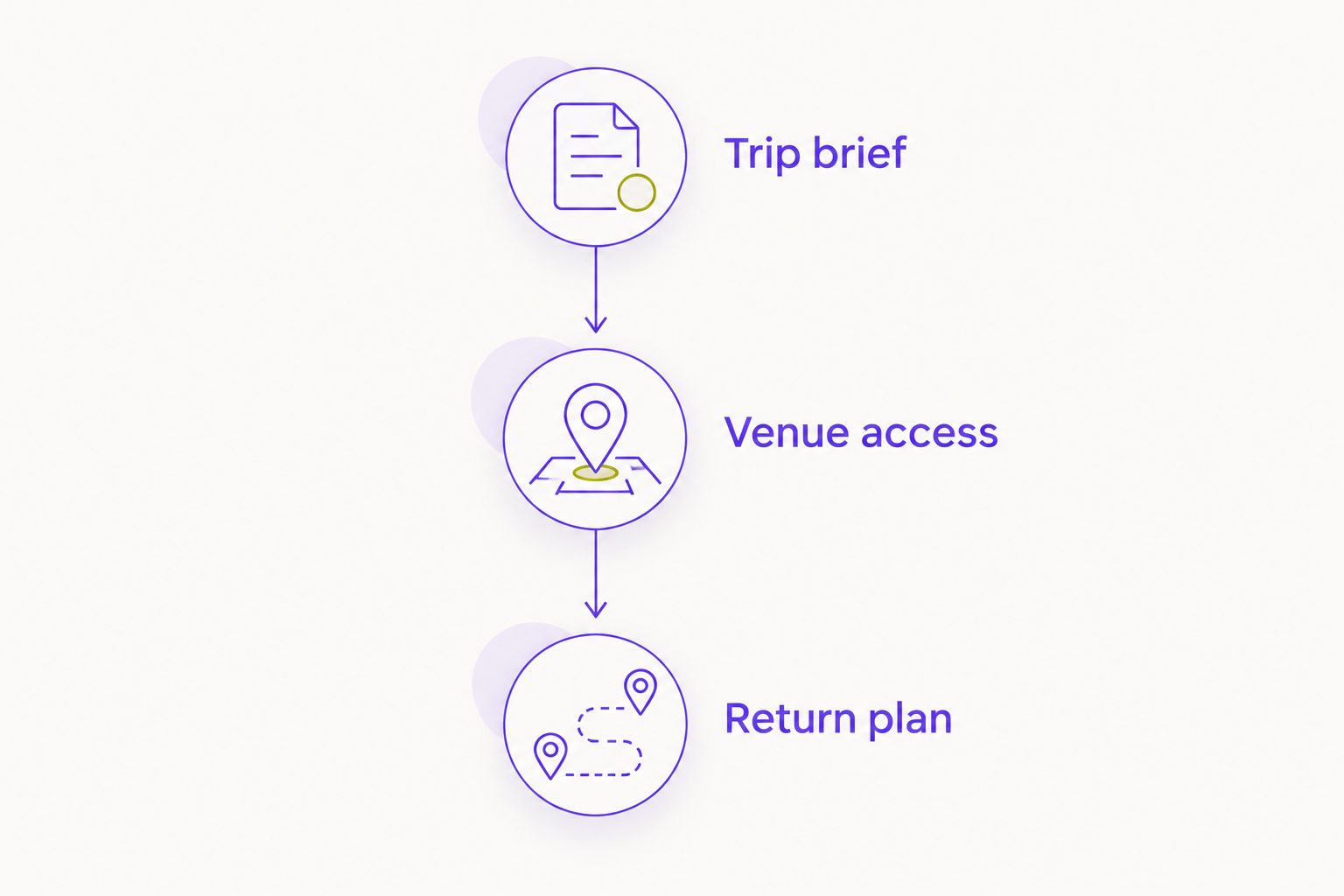
Build the request around 3 planning checkpoints: the trip brief, venue access, and return plan. These checkpoints organize the conversation; they are not a substitute for the provider's confirmation.
Trip brief
State the event date, passenger count, starting address, destinations, and required arrival time. For a 2026 outing, include the complete date rather than relying on a weekday or an event nickname.
Name 1 lead contact who can answer transportation questions and communicate with attendees. Add any luggage, equipment, or mobility needs without assuming the proposed vehicle accommodates them.
Venue access
Ask each venue where group transportation should stop and where passengers should wait. Provide the exact entrance rather than only the property name, especially when the event space has a different entrance from the main building.
Distinguish the passenger gathering time from the vehicle departure time in your instructions. The group needs a clear deadline, not competing interpretations of when to arrive.
Return plan
Specify the return destination and who makes the departure decision. If some employees intend to leave independently, establish that before describing the event as a shared round trip.
Ask how itinerary changes should be communicated and what terms apply. Keep those answers with the written reservation details rather than relying on a conversation remembered by one organizer.
The strongest reservation request tells the provider what the trip must accomplish. It leaves vehicle suitability and service terms to explicit confirmation rather than assumptions about what a party bus includes.
Request Your Corporate Transportation
Share your event date, passenger count, pickup locations, and return plan.
How these options are ranked
The ranking follows schedule fit, group fit, pickup clarity, venue access, return accountability, and written scope. A shared-destination party bus comes first because it directly matches a team outing with common travel needs; the other formats address different scheduling or group requirements.
This is an itinerary-based buying guide, not a vehicle inspection or operator performance ranking. For your 2026 booking, use the recommendations to choose what to request, then compare the provider's written response against the same criteria.
Which corporate transportation option should you choose?
Choose a shared-destination party bus when the team travels together from start to finish. Choose the multi-stop format when the activities and route are settled, and separate arrival transportation when colleagues reach the area on different schedules.
For a smaller formal gathering, compare a limousine before committing to a party bus. The right choice is the arrangement that fits your passengers and itinerary without leaving the return journey unresolved.
FAQ
What's the best party bus option for a corporate team outing in West Palm Beach?
A shared-destination party bus is the best starting point for a team with a common pickup, event, and return schedule. Limospb provides party bus transportation in the West Palm Beach and Palm Beach area; request confirmation against your passenger count and itinerary.
Should we choose a party bus or a limousine for a business dinner?
Choose according to the group and itinerary, not the business dinner label. Compare a limousine for a smaller formal gathering and a party bus for a team traveling together, then confirm passenger and luggage fit.
Can we request several stops for a corporate party bus outing?
Include every proposed stop in the initial transportation request. Ask the provider to confirm the route, pickup arrangements, timing, and applicable terms before treating the itinerary as agreed.
What should I send when requesting corporate party bus transportation?
Send the event date, passenger count, pickup address, destinations, required arrival time, and return plan. Include a lead contact and any luggage, equipment, or access requirements.
Should airport transfers be part of the team party bus itinerary?
Separate airport transfers from the outing when colleagues have different arrival schedules. Once everyone has assembled, the shared party bus trip can begin from an agreed meeting point.
How do we handle employees who want to leave the event early?
Identify independent departures before confirming a shared return plan. Ask the provider about suitable arrangements rather than assuming the group's vehicle can accommodate conflicting schedules.
What should we confirm before reserving transportation for a 2026 outing?
Confirm the proposed vehicle category, passenger fit, route, pickup instructions, return arrangements, and service terms in writing. Ask how changes are communicated and keep the agreed details accessible to the lead organizer.
One last thing
Plan the return before polishing the outbound trip. A clear arrival gets the team to the event; a clear return tells employees where to gather, who controls departure, and how they will reach the agreed destination.
Before sending your request, read the itinerary from the final drop-off backward. Any unanswered question about the return belongs in the booking brief now, not in a message sent as the event ends.