Plan wedding transportation between separate venues by working backward from each required arrival, assigning passengers to every transfer, and confirming pickup instructions with both venues and your transportation provider. Include the couple’s movements, guest transfers, and the return journey in the same schedule; a route between addresses alone does not account for boarding, photographs, or venue access.
- Wedding transportation needs a separate passenger list, pickup location, and arrival deadline for every venue transfer.
- Limospb serves couples seeking chauffeured wedding transportation in Palm Beach and West Palm Beach.
- Choose a black car, limousine, or party bus around confirmed passenger needs, not appearance alone.
- Confirm the return journey before sharing the final wedding shuttle schedule with guests.
How do you plan wedding transportation for separate ceremony venues?
Build the schedule around arrival deadlines, not estimated driving time alone. For a 2026 wedding, your transportation brief should identify who travels, where each journey begins, and who can authorize changes.
Limospb provides chauffeured black car, limousine, and party bus transportation for weddings in Palm Beach and West Palm Beach. Start a reservation request with your actual itinerary rather than asking for a vehicle without explaining its assignments.
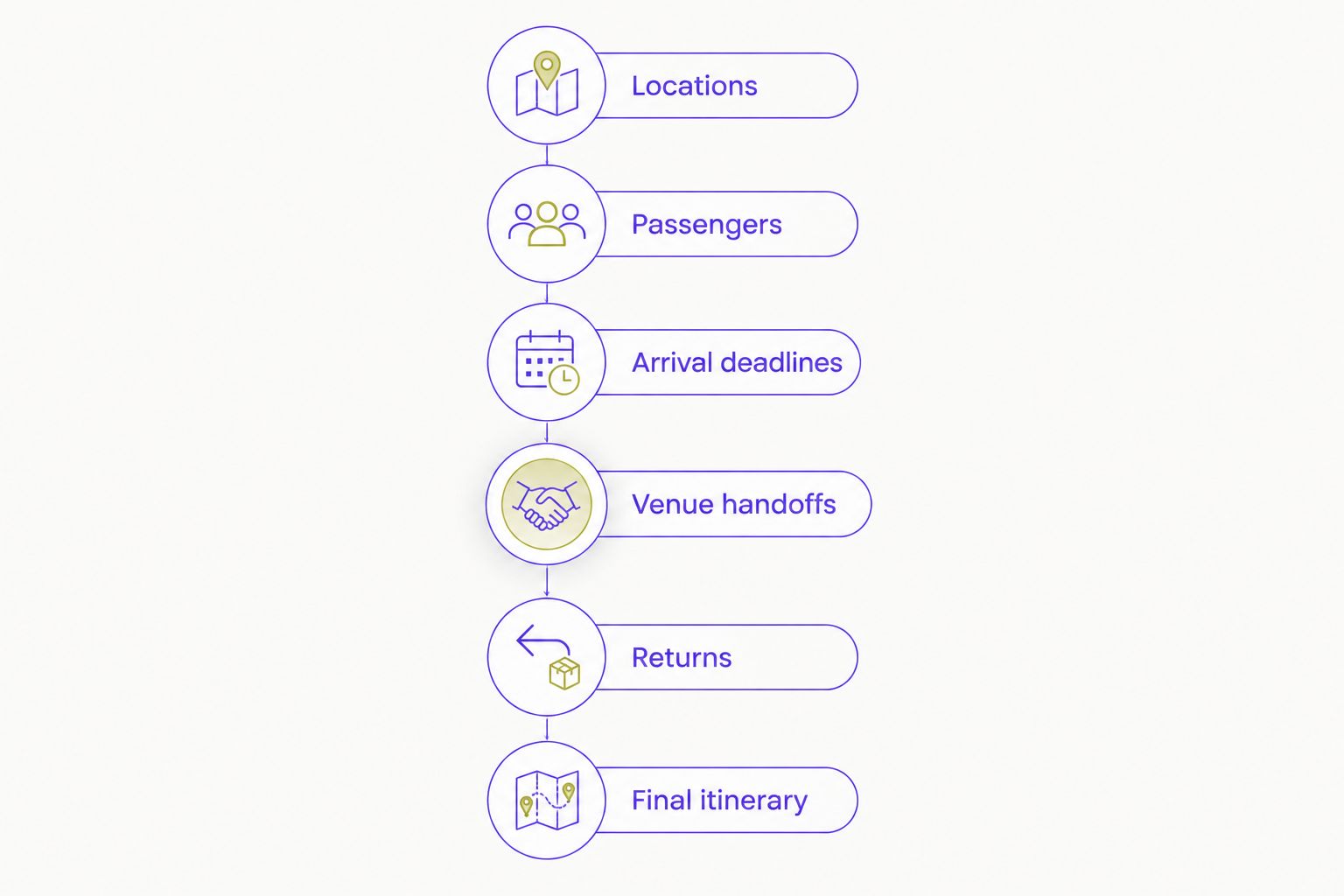
1. List every location and required arrival
Write down the getting-ready location, ceremony venue, photograph locations, reception venue, and final destinations. Use the specific entrance or loading location, not just the property’s street address.
If your celebration includes separate ceremonies, treat each ceremony as its own arrival deadline. Identify which guests attend each event and which passengers need transportation between them. Do not assume every person follows the couple’s route.
Ask each venue when passengers should arrive and where vehicles can stop. An arrival at the property entrance is not necessarily an arrival at the ceremony room.
2. Assign passengers to each journey
Create a passenger list for every leg, including the couple, wedding party, relatives, and guests requesting transportation. A person needing a hotel pickup does not automatically need a return to that same hotel.
Record mobility requirements, child-restraint needs, luggage, and anything passengers will carry. Share those details before vehicle selection, and ask the provider to confirm the proposed arrangement meets them.
Keep individual needs separate from public guest instructions. Your transportation contact needs enough information to coordinate assistance without distributing private details to the entire guest list.
3. Work backward from each event
Start with the required arrival, then account for unloading, the journey, boarding, and the pickup procedure. Ask the transportation provider to review the route and scheduling assumptions rather than applying a generic travel allowance.
Use your Palm Beach wedding transportation timeline to connect these movements to the wider wedding schedule. Hair and makeup, photographs, ceremony access, and reception entry must agree with the transportation plan.
For your 2026 schedule, record both the passenger meeting time and vehicle departure time. Label them clearly so guests do not mistake departure for the moment they should begin gathering.
4. Confirm the handoff at each venue
Name a transportation contact at the departure venue and another at the destination. Confirm who gathers passengers, who checks the list, and who tells the chauffeur the group is ready.
Ask the venues about loading areas, access restrictions, and any instructions the chauffeur needs. If a proposed vehicle cannot use the intended entrance, resolve the pickup location before sending guest directions.
Keep the couple out of routine dispatch decisions. Assign a planner or trusted coordinator to handle missing passengers and communicate approved schedule changes.
5. Plan returns and exceptions
Confirm whether guests leave together, in scheduled groups, or through individually arranged transportation. Specify destinations rather than using a vague instruction such as return to the hotels.
Identify passengers leaving before the reception ends and anyone traveling somewhere different afterward. Ask how changes are handled and what the confirmed service includes; never assume the vehicle remains assigned throughout the celebration.
6. Share one final itinerary
Send the same approved transportation schedule to the provider, planner, and relevant venue contacts. Give guests a shorter version containing only their meeting location, meeting time, destination, and contact instructions.
Put a revision date on the 2026 itinerary and replace outdated copies whenever an assignment changes. Ask recipients to acknowledge the final version so a revised pickup does not remain buried in a message thread.
Why this matters
Separate venues turn wedding transportation into a chain of handoffs. The ceremony departure, photograph stop, reception arrival, and return trip each need an owner and a clear instruction.
A confirmed vehicle is not a complete transportation plan. You also need agreement on the passenger group, permitted pickup point, and next destination. That distinction matters when the couple and guests follow different schedules.
For a 2026 wedding with multiple ceremonies, tell the provider whether everyone attends every ceremony. That decision changes the assignments before vehicle selection even begins.
Which wedding transportation arrangement fits your itinerary?
Choose the service around the journey you need to coordinate. Limospb offers black car, limousine, and party bus transportation; confirm the proposed vehicle’s seating, access, and suitability before accepting an assignment.
| Arrangement | Best for | Planning advantage | Limitation to resolve |
|---|---|---|---|
| Black car | A separately scheduled couple or family transfer | Keeps that passenger group on its own itinerary | Confirm passenger and baggage fit for the assigned vehicle |
| Limousine | A wedding group requesting limousine transportation | Gives the group a defined shared transfer | Confirm access, seating, and boarding suitability |
| Party bus | Guests requesting a shared party bus journey | Organizes participating passengers around a common departure | Confirm the vehicle suits the route and passenger requirements |
| Separate guest and couple assignments | A couple making photograph stops while guests travel onward | Keeps different destinations explicit | Requires separate passenger lists and coordination |
Do not select by vehicle label alone. Ask which vehicle is proposed for the actual passenger list and route. A name does not establish seating capacity, accessibility, or room for personal belongings.
When should the couple travel separately?
Use a separate assignment when the couple’s next destination or departure time differs from the guests’. For example, a photograph stop belongs on the couple’s route only if guests are not expected to attend.
The advantage is a clear distinction between the wedding party’s movements and the guest transfer. The trade-off is another assignment to coordinate, including its own contact, destination, and departure approval.
When does a shared guest transfer make sense?
A shared transfer fits guests traveling from the same pickup location to the same destination on the same schedule. Confirm who intends to use it before treating the full invitation list as the passenger count.
The advantage is a common set of instructions. The limitation is that late arrivals and different departure preferences still need a plan; a shared journey does not eliminate individual exceptions.
Why wedding transportation plans vary between venues
The route is only part of the decision. Review these factors with your planner, venues, and transportation provider:
- Passenger assignments: Different attendance lists create different transfer needs, especially when not everyone attends every ceremony.
- Arrival requirements: Venue access and event schedules determine when passengers must be ready to enter, not merely reach the address.
- Pickup access: A designated loading point must work for the proposed vehicle and the passengers using it.
- Photograph stops: A stop for the couple changes that assignment without necessarily changing the guest itinerary.
- Passenger needs: Mobility assistance, child restraints, and carried belongings require confirmation before the vehicle is assigned.
- Return destinations: Multiple hotels or early departures require explicit instructions rather than one general return request.
Avoid using a single timetable for groups with different obligations. Keep the main itinerary together, but give every journey its own passenger list and destination.
What should you include in a reservation request?
Send a clear brief that lets the provider evaluate the full assignment. A request for wedding transportation should include:
- The wedding date and each location’s full address.
- Required arrival times and proposed departure times.
- Passenger counts for each journey, not just total attendance.
- The preferred service type and any passenger requirements.
- Photograph stops, intermediate ceremonies, and return destinations.
- Venue loading instructions and the designated transportation contact.
Ask the provider to confirm the proposed vehicle, covered journeys, pickup procedure, and terms in writing. Review how waiting, additional stops, schedule changes, and a service extension are handled before approving the reservation.
Limospb is best for couples seeking chauffeured wedding transportation in Palm Beach and West Palm Beach. Request a plan around your locations and passenger needs, then check the written proposal against your itinerary. Do not treat a general service description as confirmation of a specific vehicle feature or booking term.
Request Your Wedding Transportation Plan
Share your venues, passenger groups, and required arrivals for a reservation request.
How do you keep guests informed between separate venues?
Give guests instructions for their assigned journey, not the entire operational schedule. State the meeting location, when to be there, where the vehicle is going, and whom to contact if they cannot find the group.
Include a recognizable meeting-point description approved by the venue. Avoid directions that depend on a guest knowing which entrance your planner calls the main entrance.
In your 2026 guest communication, distinguish transportation provided for everyone from transportation arranged only for named groups. Ask guests to confirm their plans and send changes to the designated coordinator rather than directly to multiple people.
Should the chauffeur wait during the ceremony?
Confirm the service arrangement before building the next transfer around it. Ask whether the proposed assignment includes remaining at the venue, returning for a later pickup, or another agreed arrangement.
Waiting provides continuity only when it is part of the confirmed plan. If a later pickup is arranged instead, record its meeting location and contact procedure separately so nobody assumes the vehicle is already outside.
Who should manage transportation on the wedding day?
Assign a planner or trusted coordinator who has the final itinerary and authority to communicate approved changes. Give the transportation provider that person’s contact details and identify a backup.
The coordinator should check passenger readiness and speak with venue contacts. Keep last-minute route or timing requests with that person so the chauffeur does not receive conflicting instructions from different guests.
FAQ
How do I plan wedding transportation when the ceremony and reception are in different places?
Plan a separate transfer with its own passenger list, pickup location, departure time, and required reception arrival. Confirm venue access and the return journey before sharing guest instructions.
Should our wedding guests ride with the wedding party?
Guests should share the wedding party’s transportation only when their destinations and schedules match. Separate assignments make sense when the wedding party has photographs or another stop that guests will not attend.
Can we use the same vehicle for multiple wedding venues?
Ask the provider to confirm whether the same vehicle can cover your complete itinerary. Supply every stop and required arrival, and obtain written confirmation rather than assuming the initial reservation covers later transfers.
What should we ask before reserving a wedding party bus?
Ask the provider to confirm the proposed vehicle’s passenger capacity, boarding suitability, venue access, and included journeys. Share mobility requirements and carried items before approving the assignment.
How should we arrange wedding transportation for guests at different hotels?
Assign each hotel a clear pickup plan and confirm which guests will use it. Have the provider review whether the proposed route and departure sequence meet the ceremony arrival requirement.
Does wedding transportation automatically include the ride home?
Do not assume wedding transportation includes the return journey. Confirm the final pickup location, departure arrangement, destinations, and covered service in the reservation.
What should we send Limospb when requesting wedding transportation?
Send Limospb the wedding date, venue addresses, passenger counts by journey, required arrivals, planned stops, and return destinations. Include passenger requirements and a designated coordinator so the request describes the complete assignment.
One last thing
Check what happens immediately after passengers step out. A transfer is not operationally complete until guests know where to go and the next departure has a responsible contact.
Before approving your 2026 transportation itinerary, read it as a guest unfamiliar with either venue. If you cannot identify where to stand, when to be ready, and whom to call, revise the instructions before sending them.